1.8 million scientific articles are published every year 50% of them are read only by the author and the editor 90% of them are never cited and shared Nowadays people gather information from social media, television, and the internet http://youtu.be/GA8RsnezFIg people in academia these days are promoting their journal articles on social media and blogs to increase traffic and citations
Science and Technology: Public Attitudes and Understanding
http://www.nsf.gov/statistics/seind12/c7/c7h.htm. The Internet is the main source of information for learning about specific scientific issues such as global climate change and biotechnology. Americans are now about equally likely to rely on the Internet as on television as their primary source of general science and technology (S&T) information. Many Americans continue to give multiple incorrect answers to questions about basic factual knowledge of science or the scientific inquiry process. In the United States, levels of factual knowledge of science have been stable for more than a decade.
Your original ideas can take center stage, uncensored. Here are some best practices:
Use Categories (tags)
Create an engaging Meta-description (first 160 characters) = your thesis statement
Focus on having an Eye-catching title
Include In-text links (hyperlinks) which will increase traffic to your blog
Embed Social sharing buttons such as "tweet this"
Use Hootsuite to promote repeatedly, also use Editorial calendar to Schedule Posts
Learn how to use Headings (H1) in html code to improve readability
Include Images (convey emotion, illustrate a metaphor, evoke curiosity, complement your title)
Include factual content (with sources) and write professionally (edit and proofread)
Create a careful bio that established credibility and a way for readers to contact you
Review web analytics for the kinds of questions people type into search engines like Google or Bing that deliver visitors (this was also part of the ACS Reactions talk in San Francisco and the CalBikeSummit)
Consider connecting your blog to your facebook or twitter feed. Content first = write what you know Adopt a publishing schedule = one post per month or one post per week, for example Let your content be driven by a theme = goes together with identifying your audience Keep it professional = blogs are public and your identity may or not be anonymous http://chrisguillebeau.com/how-to-start-a-blog/
Does my blog matter?
Hundreds of millions of blogs are online today. Thousands more are started every day. Anyone can start a blog in 5 minutes, but very few will start blogs that matter. http://fizzle.co/start-a-blog-that-matters If the purpose of your blog is for yourself only, then you don't have to worry about number of visitors. I prefer to keep my blog ad-free, which compromises the amount of traffic that google will direct to my site. However, I feel it makes my page more readable so that the audience is organic and focused on my content. Also, I use it to uncover themes in my life and to track events and items that I have recycled so that I can manage my tendency to hoard physical objects that I have attached sentimental value to but that are really arcane pieces of junk.
How to engage effectively
Blogger has a feature where you can follow other blogs like yours. Alternative is RSS feeds. RSS stands for Really Simple Syndication or Rich Site Summary Another idea is to create a “Follow this blog via email” listserv. Use the 411 formula to manage your engagement 4 retweets, 1 response back, 1 original posting = 30 minutes per day People following you for one reason don’t want to hear about stuff in your hobby area Blogging is such a great way to get expertise out. When you read/follow a blog, make sure to comment to get your name out. It is good to engage people. Start lively dialogue. Could be a link to a potential employer to connect you with a job. People within companies support blogging. It brings people closer to customers, companies can build loyal following. I learned this at the Virtual Networking for Grad Students event at University of California, Riverside http://events.ucr.edu/cgi-bin/display.cgi?comp_id=33367:20101104153000
hosted by Jan McCorkle, UCR Career Services
Blogging by the numbers
43% of bloggers use Wordpress 35% of bloggers use Blogger 16% of bloggers use Tumblr + TypePad + Posterous 6% use other platforms 31 million bloggers in the US 81% never make $100 from blogging Wordpress has 42 million blogs 329 million people view a blog 25 billion pages are viewed each month 500,000 new posts a day 400,000 daily comments 35% actively blog at least one time per month 65% haven’t updated their blog in one year or more 60% of businesses have a business or company blog http://www.jeffbullas.com/wp-content/uploads/2012/08/State-of-Blogging-in-2012.jpg
There are so many blogs out there, it's unlikely that you will garner a huge audience, so go ahead and write your heart out. You may just find a kindred spirit or two out there who really get a kick out of what's going on in your mind.
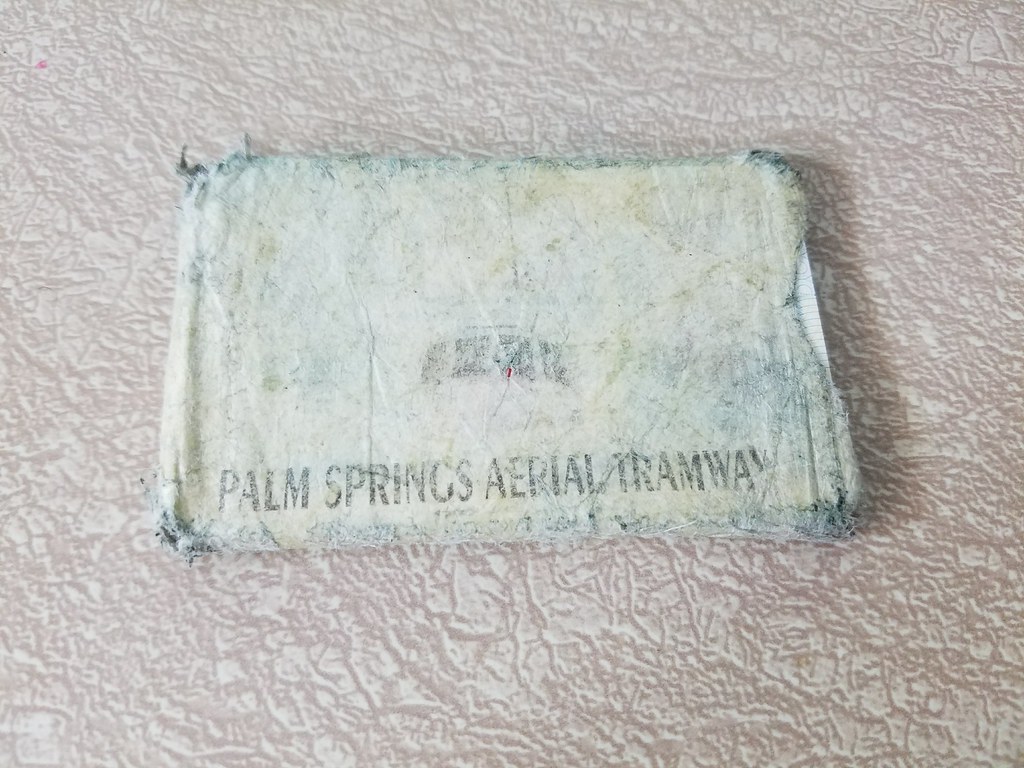
In the summer of 2012 (definitely 6 years ago) we purchased a season pass for the Palm Springs Aerial Tramway. The pass came with an envelope made of Tyvek. I have been using that for a wallet ever since.
January 2018
Before this I was using a plastic Ziploc bag, so I felt this Tyvek thingy was an upgrade. People told me that was weird until I went to a stagette party in 2011 and one of the other bridesmaids was also using a Ziploc bag for a wallet. No surprise because she was also a fitness queen.
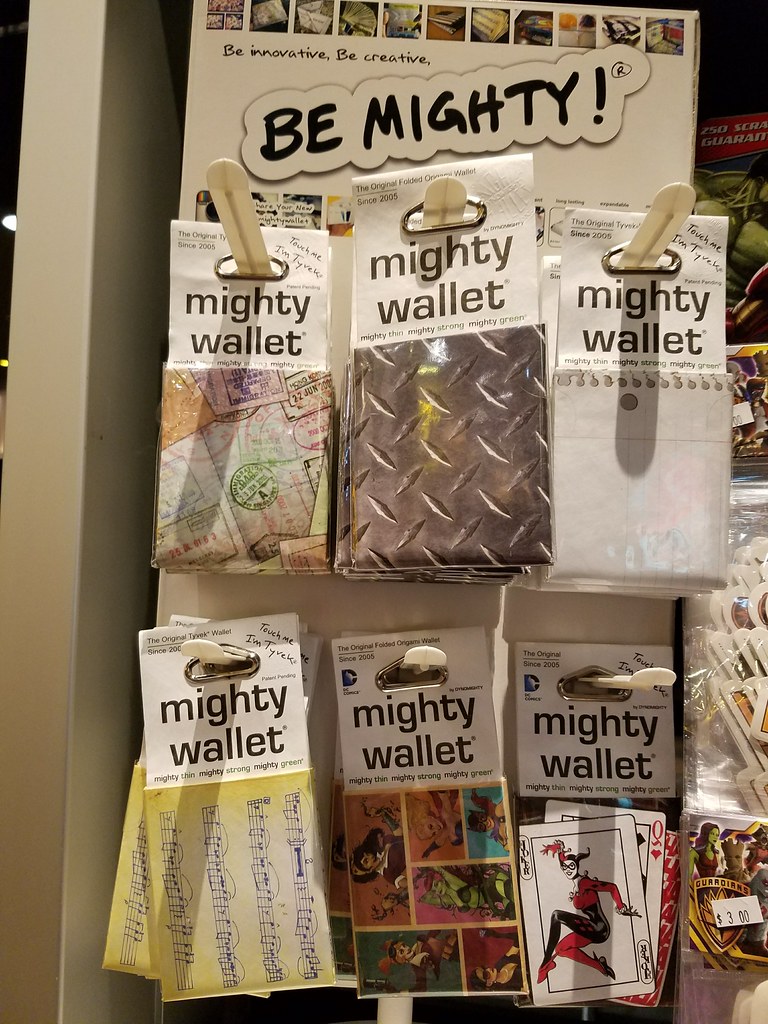
Yes, the logo is definitely faded and there are holes forming in the corners, but can you tell me another material that would hold up this well and be so lightweight and compact? We were at the movie theater January 2018 to see the movie 'The Post' and in the lobby they were selling wallets made of Tyvek.
January 2018
These wallets cost $15.00 each which kind of seemed like a lot to me, especially considering the one I've been using was given to me. ProTip: Tyvek envelopes can be ordered from USPS.com in packs of 10 for free.
I was so curious, as a chemist, about what kind of material would hold up so well and it turns out that it is a form of plastic. Plastic is derived from hydrocarbons (petroleum) and this type of plastic is high-density polyethylene (HDPE). This is a common plastic in the home, one major use is milk jugs.
What makes Tyvek so strong is that the long chains are not branched. The polymer is formed into thin sheets of parallel fibers. More about the manufacturing process can be seen here.
Last year, DuPont celebrated 50 years of Tyvek and it has found many uses. If you are done with the Tyvek product, you can recycle it at any location where you drop off plastic shopping bags.
If you are interested in the Summer Pass for the Palm Springs Aerial Tramway, the cost is $80 for Adults and they go on sale May 1st. You get unlimited rides up Mt. San Jacinto until Labor Day.
January 2018
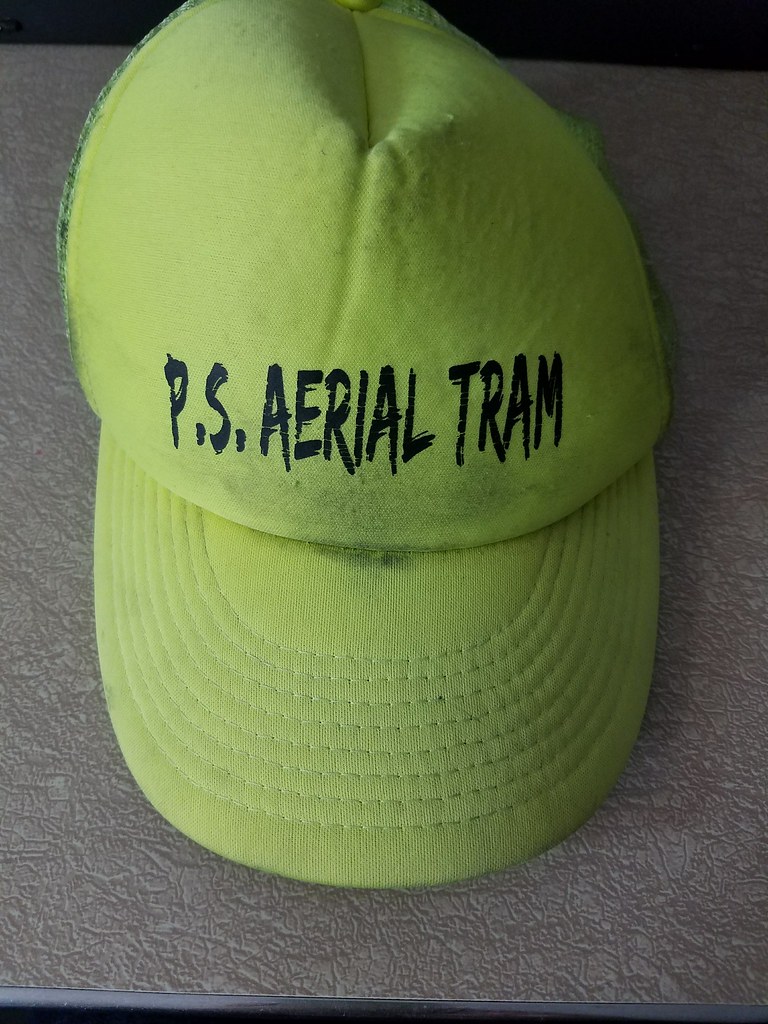
BTW I also bought a neon yellow "trucker hat" in summer 2013 and I still wear it almost every day. I think my mother-in-law was horrified because she offered to buy me ANY hat at the gift shop and I chose this one over all the other cute frilly girly styles.
Even though "trucker hats" are cheap, they are durable and functional. With a plastic mesh back and a large, nearly vertical foam front, this "trucker hat" keeps me cool and I love wearing it while walking or biking because I feel safer because it's "safety yellow." Look out, I'm walking here!
August 2013
What I love about my Tyvek wallet is that I can put it in my fanny pack and hit the roller rink, I can slide it into my sports bra and go for a run, I can fit it into my seatpost bag on my road bike, I can zip it into the side pocket of my yoga pants. It goes where I go and it's slim and durable.
Also, Tyvek is water-resistant and the plastic driver's license, credit card and insurance card inside together with the emergency $20 bill aren't harmed by a little teeny bit of perspiration. So go ahead and get your sweat on! Tyvek is a durable material that can handle whatever you are into.
Unless you're into finely dispersed iron oxide or zirconium oxide solid
superacid catalysts above 700 degrees Farhenheit, in which case your Tyvek wallet could be melted down to a wax.
Shabtai, Xiao and Zmierczak. "Depolymerization-Liquefaction of Plastics and Rubbers. 1. Polyethylene, Polypropylene, and Polybutadiene." Energy & Fuels 1997, 11, 76-87.
The 255th ACS National Meeting in New Orleans had over 15,000 attendees. The conference theme was "Nexus of Food, Energy & Water" although most of the presentations I attended were about chemical education (CHED).
Sunday, March 18, 2018
CHED 37 Diane Bunce, What makes a "C" student a "C" student? What are the differences between "A/B" students and "D/F" students? Research at the US Naval Academy (USNA) reveals that general chemistry students who get "Cs" know they should be using deep study but they haven't yet fully mastered the deep study approach. "A/B" students use deep study and "D/F" students use surface study. A second study at the USNA found that "A/B" students look at solved problems in the text (self-help, individual) while "D/F" students use peer learning facilitators (PLF) and tutors (help from other people, cooperative).
ACS Board of Directors Meeting There is an ACS Scholars Program which awards renewable scholarships to underrepresented minority (URM) students majoring in undergraduate chemistry-related disciplines, and are also intending to pursue careers in chemistry-related fields. Selected recipients are awarded up to $5,000* per academic year. To date, over 3,000 students have received a funding from the ACS Scholars Program. https://www.acs.org/content/acs/en/funding-and-awards/scholarships/acsscholars.html
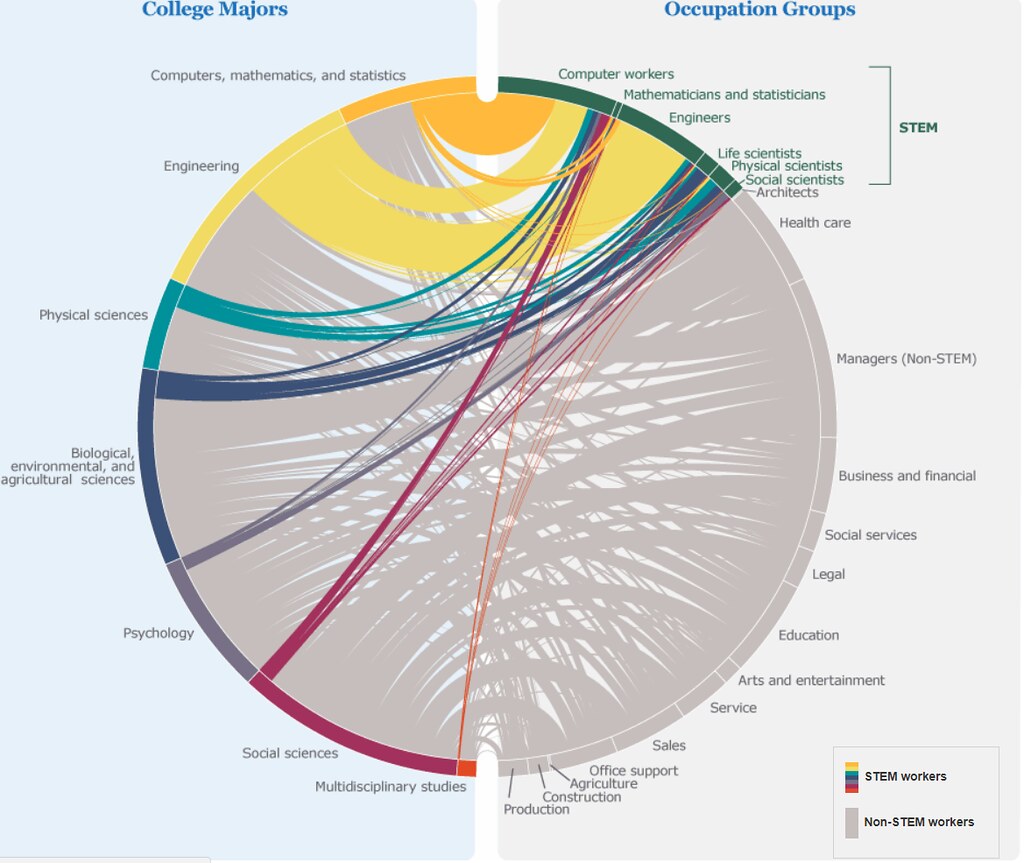
Keynote Speaker Lisa Balbes "Nontraditional Careers for Chemists: Thinking Outside the Beaker" Lisa started out by presenting some data: in one year there are 2704 PhDs awarded in but only 501 faculty positions available. There are a range of careers besides academia. Further, doing a post-doc is only useful if you are planning a career in academia. Doing a PhD in the chemical sciences teaches time management, ability to learn quickly, ability to manage a project that are transferable skills for careers outside of academia. Lisa showed a Chord, a cross between a bar chart and a flow diagram, showing the size and links between various categories. US Census data from the 2012 American Community Survey looked at which US college major subjects are commonly associated with employees in STEM jobs. The graph here shows that a minority of students who graduate with a STEM major end up working in a STEM occupation. The majority of STEM graduates end up in occupations such as management, health care, education, sales, business, legal, etc.
The good thing about attending the Board of Directors Meeting is that you get an overview of the conference and that can give you ideas of what you want to see. I learned about the session PRES: Science Cafes & Engaging the Public: Techniques for Hosting Successful Events. After we checked into our hotel, we came back to the convention center and I went to see
PRES 7 Science Cafes & Engaging the Public: Techniques for Hosting Successful Events by Pete Joseph Bonk, the session co-presider representing the Rhode Island ACS local section. He gave us some guidelines for planning events. (1) create a 45 minute presentation. Keep your talk on science. Tell them what we know, how well we know it, how do we know, what are the known unknowns, what are possible unknown unknowns, what are common misconceptions, what are our assumptions, are there any complications? Show humility. Avoid projections & predictions. Use unbiased sources (not news articles). Challenge your audience, don't avoid complexity. The audience has come to learn and they will trust you to inform them, you are an expert. This talk will be a basis for part (2) a large-group discussion. The total event is 2 hours, so allow for significant participation in the second part of the event. You function as a moderator, not a director, of the conversation. Above all, show your enthusiasm and have fun! Advertise your events on facebook, via email and using fliers/postcards.
PRES 8 From science cafes to a state-wide STEAM festival by Preston John and Tara A. MacDougall. In 5 years, they hosted 11 science cafes at their Discovery Center (science museum). Lessons learned: props and demos are essential, get experienced speakers, coach your speaker on what to focus on (takaways and problem solving strategies), involve the Boys & Girls club to be inclusive of diversity, use hot topics (e.g. bioengineered mosquitos to fight Zika virus), make the event two-way engagement (get volunteers to participate, do not just lecture). There is a Science Festival Alliance at MIT that can provide you training. They have a 5 year plan to create a non-profit so that the STEAM festival can become self sustaining. Currently they rely on corporate donations in $10,000 increments. The total cost of the festival exceeded $300k. With corporate partners, they can use the event to recruit the workforce of the future (e.g. Schwann cosmetic company that has trouble finding workers). Including the arts allowed for involvement of the country music hall of fame, kids made Jason Aldean style hats out of paper. Also there was a video contest with a GoPro as a prize where kids used innovative instruments to play a B# note. Video entries were tagged with #besharp
HIST 14 "Food at the Crossroads: Chemistry's Role in Sustainability, Past & Present" This is pretty much the only talk I went to that would qualify for being at the "Nexus of Food, Energy & Water" and I didn't even stay very long, but it was at least tangentially related to my passion for gardening and the experiment we do in our second analytical chemistry course about scoville heat units of a habanero.
PRES 9 "Brewing Chemistry” in Detroit: Maintaining a long running Science Café by Meghann N Murray. Her website is here. There's funding for these events here. The ACS Committee on Local Section Activities (LSAC) funds new local section projects through Local Section Innovative Projects Grants (IPGs). Application deadlines occur twice yearly: January 31 and June 30.
At my poster (CHED 160) I got to catch up with my BFF Cheri (Barta) Rossi.
Monday, March 19, 2018
CHED 237 Amanda Holton from UC Irvine presented her work on active learning in massive lecture courses. I met her last year at the Collaborative Chemistry Conference in Oxnard, CA.
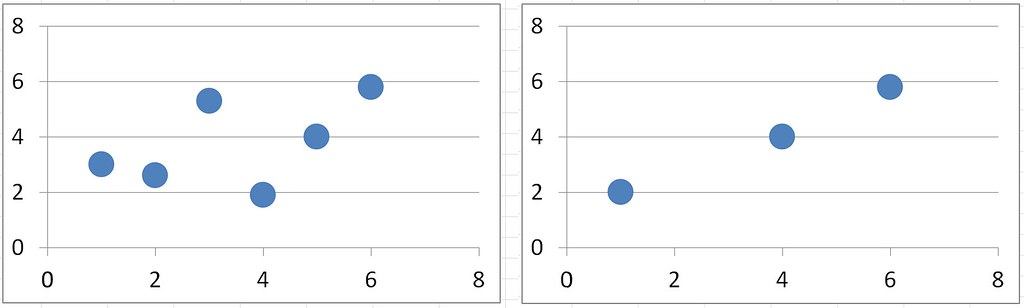
CHED 253 Justin Carmel at Florida International University studied students' ability to (1) engage arguments from evidence (2) plan and do experiments (3) analyze and interpret data and (4) construct explanations. Students were given two graphs, see below, and asked "What if anything can you say about this data? Can you make a conclusion?" He found that students agreed that the left graph was inconclusive, but that students tended to make a conclusion from the graph on the right.
He also had some cool assessment based on Rhodamine. He showed students a UV-Vis absorbance spectrum and asked them "Based on this analysis, do you believe it? What are the similarities and differences? What would the solution look like based on the absorbance spectrum?" A third activity was based on Phlogiston theory. Data was presented to students (burning magnesium, forming magnesium oxide) and students were asked to explain their reasoning using Phlogiston theory (or not).
CHED 254 Dulani Samarasekara from Mississippi State University presented data evaluating designed laboratory partnerships. Her groups were (A) free choice (B) random (C) side to side (D) high-low and (E) cohort. The side-to-side partnerships were where the ACT math score was similar between partners and the high-low partnerships were where one person in the group had a higher ACT math score than the other. The model inputs were post-lab critical thinking questions, survey attitudes, and lecture course final exam grade. Groups (4) and (5) had the highest cooperation based on survey data, while group (4) had the highest average final exam score. This is two semesters worth of on-sequence general chemistry (FA12 and FA13) with N = 1400ish. Group (4) enjoyed the partnerships the most. Future work will examine the effect of gender and ethnicity. The audience member asked if she conducted any face-to-face interviews.
CHED 240 Nawaporn Sanguantrakun from St. Louis College of Pharmacy measured the effects of active learning and flipped classroom on the success of students enrolled in a two year integrated chemistry sequence. She used POGIL and PollEv to create the active classroom environment. A set of 3 cups was used to indicate whether a group was (Green) no problem, in progress (Red) stuck, need help or (Gold) finished, ready to move on. This is how she managed the dynamic classroom environment with a large enrollment. She provided students a team checklist to manage behavior and to allow students to evaluate their teammates (turn around, participate, focus, etc.). She also found that assigning team roles formally, as suggested by Moog, was better. There were team presentations for share-out. A reflection sheet was also used and collected for points. Her grading scheme overall was 60% cumulative exam, 25% midterms, 10% in class activity (3% quiz, 4% POGIL, 3% PollEv), and 5% outside class activity (supplemental instruction, office hours, review session). Her in-class lectures were 5-10 minutes long and interactive (or maybe that was the outside class video, IDK).
CHED 242 Monica Illies from Drexel University spoke about assigning a "Study Buddy" to students in her general chemistry (freshmen) and introduction to medicinal chemistry (seniors). She found via survey that her students were not valuing employer-desired skills such as teamwork. Her "pedagogic composite strategy" involved (1) think-pair-share (2) metacognition (3) feedback. She used flipped classroom, muddiest point, clickers, tie-ins to content from her students' concurrently enrolled courses, awarding participation points, and handwritten feedback. She teaches the "Study Cycle" as recommended by Saundra McGuire. She found that her freshmen were focused on reproducing/imitating the professor, they were motivated by GPA, and they considered feedback as criticism. By contrast her seniors were focused on being original, they were motivated by career readiness, and they perceived feedback as help. A big take-home point for me was that teamwork helped students avoid "the illusion of knowing" that can be associated with studying from a book.
CHED 244 Kalyn Shea Owens, a chemist, together with Ann Murkowski, a biologist, from North Seattle College have developed a set of interdisciplinary investigations (IDIs) with funding from NSF DUE. Three examples of projects involve (1) aquaporin for water purification (2) epigenetics to teach hybridization (3) hemoglobin to teach thermodynamics. These projects engage biology, engineering and public health majors. The model they follow is: connect --> extend --> challenge. The IDIs involve students reading primary literature and collaboration. The first week students generate a drawing (model) and teachers give a mini lecture. The second week students give seminars. They tell students "Your model does not need to be correct, just well supported!" A rubric instructs that students' model should utilize 2+ disciplines and communicate clearly. They discussed threshold concepts in biochemistry. Specifically intermolecular forces.
CHED 319 Charlie Cox from Stanford University uses active learning in his TA training workshop. Stanford has 40-50 incoming graduate students to train, so they match 5 trainees with 1 experienced TA. Three days (8h/day) prior to the start of the semester are used (1) policy = honor code, sexual harassment (2) safety = manifolds, ppe, spills, fires (3) teaching = office hours, problem solving, microteach, prelab lecture. Day 3 format is that new grad students give their microteach, receive feedback, eat lunch, then present an improved version of their microteach. The TA training itself uses clickers and discussions to avoid "death by powerpoint." They pay experienced TAs $500 to facilitate. The Mentors in Teaching (MinT) program extends the 3 day training into a semester (1) goal setting (2) midquarter evals (3) observation (4) end of quarter wrap up. The overall goal is to create a welcoming environment, NOT a scary experience. Presiding over this session was Rebecca Kissling, the chemistry undergraduate advisor at Binghamton University, SUNY.
CHED 290 David Cartrette from South Dakota State University spoke in the session titled "ACS Award for Achievement in Research for Teaching & Learning of Chemistry" discussing a course developed jointly with an art teacher. He followed STEMtoSTEAM.org from Rhode Island School of Design. Scientists with creative hobbies (such as music, literature, art) are 1.7x more likely to be members of the National Academy of Sciences, 1.8x more likely to be members of the Royal Society, and 2.8x more likely to be Nobel laureates. The course they developed had a 400-level designation and enrollment with half art students and half chemistry & biochemistry majors. It was populated with first-semester freshmen (FTF). It came with an honors designation. First, they deconstructed stereotypes of artists and scientists, encouraged students to focus on their common creative process (concept, trial & error, problem-solving, discovery, final approach). They presented students with an image and used Visual Thinking Strategies (VTS) as a framework to discuss that art can mean something different to each individual (see and discuss). Students were tasked with creating a public installation which required them to think: Who is the audience? How many people pass by? What is an appropriate scale? They settled on a kinetic sculpture in the student union.
CHED 330 Jack Eichler from University of California, Riverside used Active and Blended LEarning (ABLE) in general chemistry funded by NSF IUSE. A publication from The Coalition for Reform of Undergraduate STEM Education motivated his use of flipped classroom. A concept inventory revealed that peer instruction improves student performance. Best Practices for Flipped Classroom include (1) online pre-class videos with interactive questions (2) online pre-class simulations that are interactive. These must be mandatory! (aka. worth points). Then (3) the class time should be used for problem-based learning involving case-inspired real-world issues such as sustainability and renewable fuels. Eichler combined studio-produced videos with screencapture using the playpauseit software. For simulations, he used mathematicaCDF, Norton ChemTours, and PhET sims. A quiz through the learning management system (LMS) is an effective way to gauge student progress. Worksheets with open-ended questions were graded and returned. Eichler had undergraduate SI leaders and graduate TAs attend lecture. He lowered the DFW rate from 15% to 5%. He also used ALEKS for homework. Using a responsive approach, flipped classrooms together with collaborative discussion was found to be better than collaborative discussion alone.
CHED 331 Overtoun Jenda led the "Making to Advance Knowledge, Excellence and Recognition in STEM (MAKERS)" program in Alabama, which was an alliance between community colleges and universities. The goals of this program are to improve the graduation rate, lower the DFW rate, and get more people in the pipeline for STEM careers. Freshman-sophomore pairings focused on time management, study skills and academic resources. Junior-senior pairings focused on summer internships, GRE preparation, choosing a graduate school and writing. The program components that were deemed mandatory were: check your school email, attend all meetings, maintain a 3.0 GPA and full-time student status, attend workshops and summer programs. The issues were that obtaining an IRB for a multi-institution project was an absolute nightmare. NSF funding is great but you can't start the project without the IRB. His advice: choose faculty who love working with students, not just those who love getting grant money. It was hard to recruit students due to fluidity of community college population.
CHED 293 Amy Phelps from Middle Tennessee described the differences between wet labs and virtual labs. She found that in a wet lab, students talked about the procedure (and complained about missing and broken equipment) whereas in virtual lab students discussed the concepts and theory. **If students in CHEM 102 @ CSUN work in pairs for the VLabs, they may work better** Students who did the virtual lab tended to learn the micro and symbolic aspects better, whereas students who did the wet lab learned the macro aspects better. So it seems they are both good because students who did the virtual lab didn't learn the macro aspect and students who did the wet lab could not articulate symbolic or micro level understanding.
CHED 333 Sunghee Lee from Iona College in New Rochelle, New York described the "Development of Excellence in Science through Intervention, Resilience and Enrichment (DESIRE)" which funds 6 students per year (summer stipend + tuition/fees) for 4 years. The 5 pillars of their program are Academic (peer learning), Professional (REU, industry partner, career seminars, networking, field trips), Interpersonal (learning community), Intrapersonal (reflections on service learning, academic advising, career counseling: what do YOU want? not your parents'), Intercultural (understand, honor, value, resilience, apply a cultural perspective to solving problems in diverse teams). They offer a class called "Science Society & Self" SOC490 that is an elective for the sociology major and a core elective for the college of science & math. It is offered every spring and recommended for all science majors. She gave lots of detail about the assignments for this class (see image at left). CHED 334 Marion A Franks from Virginia Tech spoke about his "Emporium" style general chemistry course. The shift in pedagogy was due to the fact that 89% of students were scoring below 40% on the ACS gen chem exam and only 3% of the students scored above the 50% benchmark. The emporium is a staffed 24h/day computer lab for students to use ALEKS. They found a decrease in DFW rate, an increase in the number of ALEKS topics mastered, and an increase on the score on the ACS exam. The peer tutors working in the emporium attend lecture and work through ALEKS. The emporium group had 2 lectures per week and 2 class meetings in the emporium whereas the control group had 3 lectures per week and a traditional recitation.
test
control
test
control
test
control
52
71
65
20
47
40
47
54
70
65
60
57
36
62
75
58
41
36
DFW
rate
ALEKS
topics
ACS
Exam
CHED 1796-1800 "STRETCH your students' minds using materials to engineer ideas about water, food and energy in the chemistry classroom," a make-and-take session.
CHED 1870 "Pasadena City College (PCC) Chemistry Club" saw Veronica Jaramillo and had a great coffee talk with her the next day.
Mississippi State Alumni and Friends Reception at Mulate's the original Cajun restaurant. Found out that they are hiring 5 faculty without any restrictions on the discipline. A great place to solve a "two-body problem."
Tuesday, March 20, 2018
CHED 1929 Lance Shipman Young at Morehouse College spoke about Peer-Lead Team Learning (PLTL) and his conclusions were that you need (1) an "Army of the Committed" so that if some faculty or administrators leave the program will survive (2) creative funding sources, they get $12,000 per year in donation from Corning (3) and willing open-minded faculty and deans. At his school, the program actually went on a 2-3 year hiatus due to a lack of these three items, but it's revived now.
CHED 1930 Rick Moog spoke about POGIL, PLTL and Pratibha. In a talk from 2005 they were using student-centered pedagogic approaches including process-oriented guided inquiry learning (POGIL) and peer-led guided inquiry (PGLI), physical chemistry online (PCOL), problem-based learning (PBL), calibrated peer review (CPR), and just in time teaching (JITT) so these ideas are hardly new.
CHED 1940 Allison Caster from Colorado School of Mines spoke about how and why she converted general chemistry in large traditional lecture sections (250 students) to smaller class size (50 students) with active learning. Using a pre- and post-test in the traditional lecture revealed that students were coming out of the class with misconceptions and poor mastery of the material. Also, there was a 20% DFW rate. The 4 Pillars that support their work are (1) learning by doing (2) finding relevance (3) communicating (4) scaffolding = start with what they know. They noted that it can be overwhelming to implement active learning given the array of techniques in the literature. Leading students to an impasse is critical. They used whiteboards and authored (or borrowed) 60+ activities. They used the science writing heuristic (SWH). There are lots of resources here. With a class size of 263 students they were able to lower the DFW from 25% to 15%. They saw a bump in attendance from 70% to 95% even though the worksheets were worth a small amount of points. Students recognized that attending class was of value. They did intentional grouping and also allowed groups to reshuffle throughout the semester.
CHED 1941 Kimberly Linenberger Cortes from Kennesaw State University in Georgia spoke about her Fall 2016 Science & Math majors cohort. The students took chem lecture and lab as well as math class and freshman seminar together. She used GoFormative and iClicker for daily group quizzes (analogous to learning catalytics). POGIL and ChemSource were the resources for in-class activities. ChemQuest and PhET were used for simulations. Camtasia was used for flipping the classroom, with embedded quizzes in the videos. The barriers to implementation were: PLTL facilitators and rooms. Also, it was difficult to get faculty to adopt high-tech video production. Her framework was Model-Based Inquiry (MBI) which (1) anchors (2) presents initial ideas (3) engages students in an activity (4) revisits hypothesis. The activities intentionally created cognitive dissonance. Labs were paired with simulations. The learning community was found to decrease the DFW rate. The flipped classroom environment was appreciated by freshmen but a more difficult adjustment for nontraditional students. Examples of her activities were flame tests, legos for dilution, and a FlinnSci activity on paramagnetism.
CHED 1943 Scott Lewis at the University of South Florida spoke about flipped classroom and PLTL in the second semester of general chemistry. He used measurable linked content (MLC). He created 47 instructional videos together with a team of 3 people. They have an upper level chemistry course that is PLTL training. Using class-level data over 8 sections, he found that the following deviations from the mean:
flipped
traditional
p value
midterm
+0.25
-0.31
0.003
final
+0.16
-0.18
0.008
The advantages to his approach is that it is scalable, covers the same content and presents a minimal cost to students. His future work involves longitudinal tracking of his former students and PLTL facilitators in analytical chemistry.
CHED 1944 Drew Meyer from Case Western Reserve in Ohio described several semesters worth of data where he used ALEKS, clickers and POGIL-like active learning in 40% of his lectures. Twice he also used pre-lecture videos. He had a large class (300 students) and a small class (45 students). Best practices dictate that if you plan to do active learning, you must begin on day 1. If you have a theater-style classroom, make a seating chart that leaves some rows open for you to move through the room. The pre-lecture videos get everyone on the same base of knowledge and a start-of-class quiz gets them there on time. He used Camtasia for his videos, no more than 10 minutes each. He measured students' attitudes toward chemistry.
CHED 1967 David Malik from Indianapolis University presented data on the success of ALEKS and PLTL on lowering the DFW rate from 40% to below 20%. He emphasized that remedial courses hinder student progress and decrease the graduation rate. Many students get stuck and never finish.
CHED 1968 Bobby Kunnath from Syracuse University in New York spoke about his experience with bridging high school and university. He is a high school math teacher plagued with students constantly asking why they need to learn math. He found chemistry is the perfect way to show students exactly why they need math skills. Also being an immigrant, he is sensitive to the communities of refugees from Congo, Somalia, Nepal, Burma, Yemen, Sudan, and Vietnam that can be found in New York. He reported that 80% of his students qualify for free or reduced lunch. The experience he provides for them ranges from 6 weeks to 1 year where students shadow and then do hands-on experiments to receive a $250 stipend when they turn in a reflective essay. This made me wonder: Why can't the chemistry placement test (CPT) be a part of Freshman Orientation? We already require a math and writing placement exam.
CHED 1969 Ranier Glaser from University of Missouri discussed his recent publication wherein he taught spectral deconvolution using Excel in a course about how to do science. A take-home point of his talk was that "If the essence of science is peer review, then we're not teaching science if we're not doing peer review." And also "The idea that scientists are objective is a myth. They're ego driven, especially the successful ones. Peer review constrains the egos. Arguments are necessary. Peer review is a way of communication." You can find more about this course here: Undergraduate Seminar in Chemistry (3).New Curriculum on Scientific Writing, Peer Review, Science Communication. Writing-Intensive. Methods for reading, locating and presenting chemical information; data management, presentation and analysis; scientific writing; scientific peer review; professional ethics.
CHED 2015 Emily Lauren Atieh of Rutgers University in New Jersey presented her chemistry game consisting of "Sleuth Problems." Students could choose to solve a problem by purchasing various pieces of information on a budget. Constants are free. If students get the problem correct they will gain money, if they submit an incorrect answer money is deducted from their budget. Using a Likert-scale tudents (N = 52) agree that the sleuth problems helped them self-diagnose their problem solving skills, encouraged them to work in groups, and helped them understand. The Likert-scale questions revealed that the sleuth problems did not help them prepare for the exam. Open-ended surveys also found that students were frustrated by the sleuth problems, namely where to begin. Finally, the open-ended survey uncovered that students felt the sleuth problems did not relate to the exam. Her future work will include a note in the IRB that students' solution maps will be collected as data.
CHED 2016 Nathaniel Beres and Aaron Roerdink from Heidelberg University in Ohio teach a course where students study the chemistry in art and then take an international trip to view the art. Stateside, students made paint & pigments, degraded the paint & pigments, analyzed the samples, discussed forgeries. They also studied the effects of acid, base and neutral solutions in contact with marble, brass, copper and clay (materials used to create sculptures). A key assignment prior to the trip is that students were delegated to serve as tour guides for the group at specific times in the overseas experience. While traveling, students completed a journal prompt for each day of the trip. Tours included a museum conservatory, a university with an art conservation program, and a world-renowned ceramics studio. Collaborating with the Psychology department gave these chemistry professors a "Universality-Diversity Scale" to assess if the program ended up enhancing students' world-view. A final assignment was for students to articulate when they observe an object that they would NOT consider "art" among the pieces they viewed during their trip. The cost per student was charged upfront as "fees" for the course $2500 / student. They refunded any unused portion of the money, in this case $700.
I read an article just before attending the conference about the hashtag #scicomm. A response article, which I have not fully read, was posted on a different media outlet about 24 hours later. I definitely do use social media to promote science. What are your thoughts?
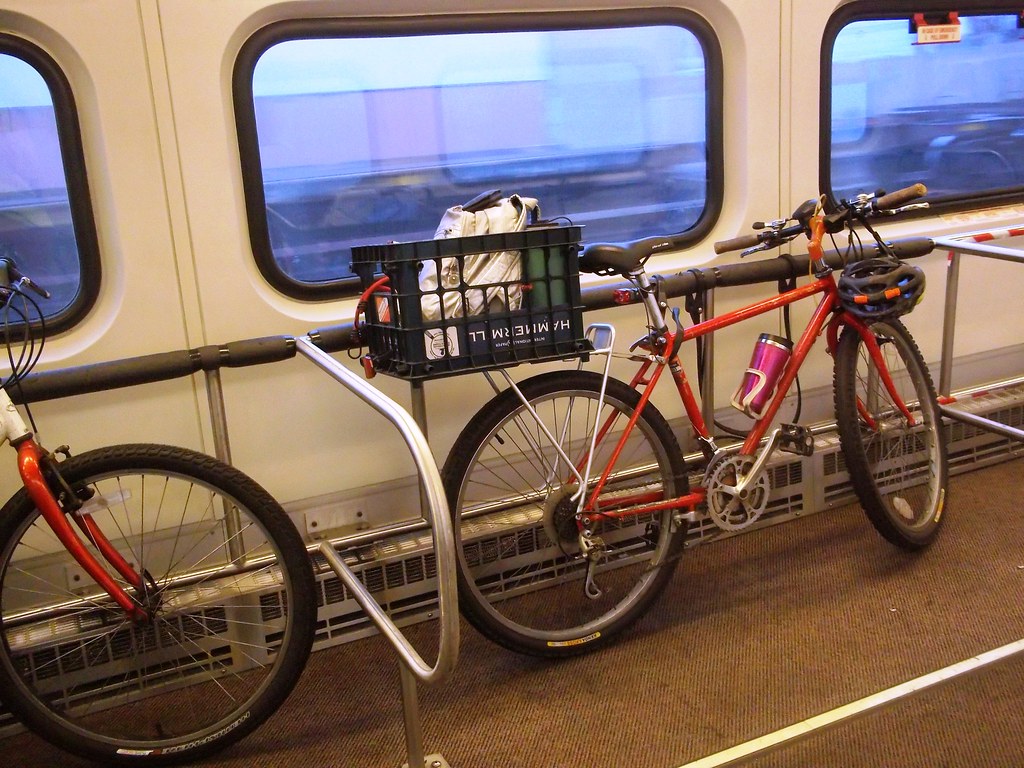
I get seasick. I get carsick. I get sick from rollercoasters. I get sick on buses. I get sick on trains. I get sick on subways. This may be a contributing factor to why I love human-powered transportation so much! Bicycling never makes me sick.
This semester was so stressful! (see previous posts eLearning then Checking in) I was so self-involved trying to be extrordinary that I forgot it's more important to keep it simple. In 2018, I hope to leave at least 6 hours each day for empty space and see what happens (how the time gets filled in). Last semester, I was scheduled so tightly that I really had no time that wasn't already spoken for. It was actually quite ridiculous. Anyway, that's a long way of making an excuse for how I would come home at 11pm (after night lab) and then have to teach at 8am the next morning. So I would dissolve Alka Seltzer Plus Night Cold & Flu in 4 oz of water and crash out. It would help me sleep no matter what.
Then, on dear husband's birthday (see previous post behind the curtain) we boarded the Catalina Express and spent the weekend out driving around in a golf cart and in cars throughout Los Angeles, Riverside, and Orange counties. My mother-in-law gave me Dramamine so that I wouldn't get motion-sick. I took the maximum recommended dose in the morning, and then took another dose 6 hours later. I felt just like I had drank an entire bottle of red wine. But also, I felt a similar feeling the next day as I felt when I had taken the Alka-Seltzer Plus Night Cold & Flu, which made me wonder about the active ingredients in each.
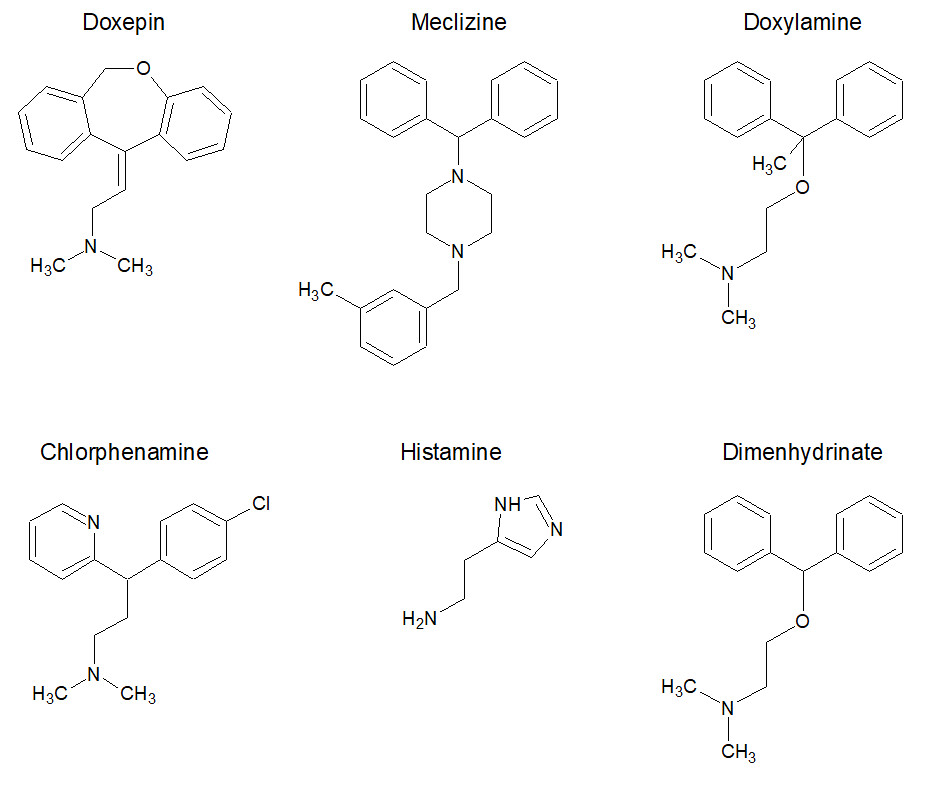
Antihistamines and the endogenous ligand
Doxepin at low doses used to treat insomnia due to its binding to the histamine H1 receptor. Meclizine is sold under the name Dramamine II (Less Drowsy Formulation). Doxylamine is a first-generation antihistamine, part of the formulation NyQuil. Chlorphenamine is part of Kirkland Signature Day/Night Time Cold Multisymptom Relief Rapid Release Gelcaps (from Costco). Dimenhydrinate (a combination of diphenhydramine and 8-chlorotheophylline) is Dramamine I. Diphenhydramine alone is sold under the trade name Benadryl among others. In college, after the 9/11/2001 terrorist attacks on the World Trade Center, I had a hard time sleeping. The student health center recommended Benadryl as a sleep-aid.
Antihistamines, including diphenhydramine, were introduced in the 1940s. Dale isolated histamine and discovered its role in nerve signal transduction. Bouvet together with his student Anne-Marie Staub synthesized and tested the first antihistamines. These compounds were too toxic; not until 1942 were the first medically useful antihistamines developed by Bernard Halpern.
I have written about the histamine H2 receptor in a previous post. There are histamine H3 and H4 receptors also, but this post is going to stay on the topic of compounds that block the histamine H1 receptor.
Second-generation antihistamines cross the blood–brain barrier to a much lower degree than the first-generation antihistamines. Their main benefit is they primarily affect peripheral histamine receptors and therefore are less sedating. These are newer drugs, but this post will continue to focus on the first-generation antihistamines, which are available over-the-counter at an affordable cost.
An advantage to the use of antihistamines for treatment of insomnia is that tolerance does not occur during regular use. A disadvantage to the use of antihistamines for treatment of insomnia is impairment of alertness, cognition, learning and memory. Overdose is possible, leading to death via respiratory depression. Diphenhydramine overdoses (0.5-1 g) whether accidental, suicide or homicide, are a common event in the United States. Therefore, poison control centers have guidelines for triage and management for antihistamine toxicity after overdose.
This research and writing has inspired me to devote my next chemistry-related post to drugs that are stimulants of the xanthine class. Dimenhydrinate, for example, is a combination of diphenhydramine and 8-chlorotheophylline. The stimulant counteracts the calming effects of the antihistamine.
Anne-Marie Staub wins Ehrlich Prize, 1969
References
Church, M. K. and Church, D. S. Pharmacology of Antihistamines, Indian Journal of Dermatology, Volume 58, Issue 3, 2013, Pages 219–224.
Mahdy, Amr M. and Webster, N. R. Histamine and antihistamines, Anaesthesia & Intensive Care Medicine, Volume 12, Issue 7, 2011, Pages 324 - 329.
Mitchell, H. A. and Weinshenker, D. Good night and good luck: norepinephrine in sleep pharmacology, Biochemical Pharmacology,Volume 79, Issue 6, 2010, Pages 801-809.
Simons, F. E. R. and Simons, K. J. Histamine and H1-antihistamines: Celebrating a century of progress, Journal of Allergy and Clinical Immunology, Volume 128, Issue 6, 2011, Pages 1139-1150.
Stojković, N., Cekić, S., Ristov, M., et al. Histamine and Antihistamines / Histamin i antihistamini. Acta Facultatis Medicae Naissensis, Volume 32, Issue 1, 2015, pp. 7-22.
Yanai, K; Yoshikawa, T.; Yanai, A.; Nakamura, T; Iida, T.; Leurs, R and Tashiro, M. The clinical pharmacology of non-sedating antihistamines, Pharmacology & Therapeutics, Volume 178, 2017, Pages 148-156.
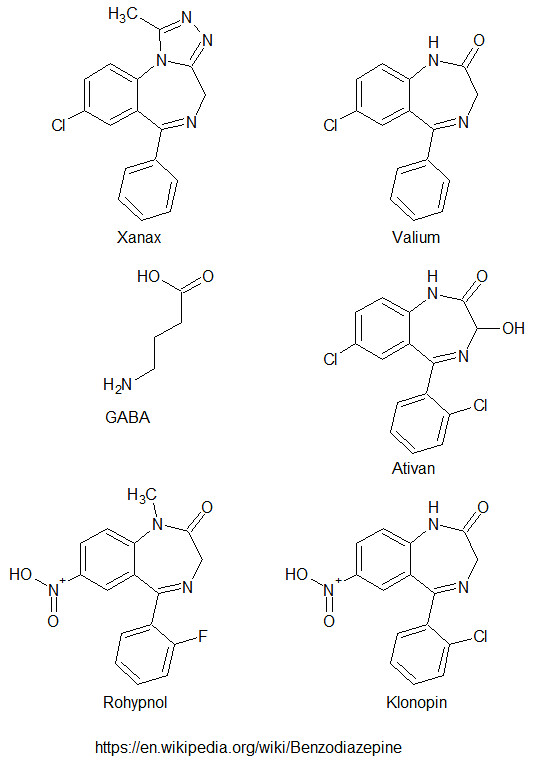
Valium launched in 1963. Ativan opened for US sales in 1977. Klonopin opened for US sales in 1975. Rohypnol launched in 1974, but was never marketed in the US. Xanax launched in 1981.
In the mid-1950s, chemists at Hoffman-LaRoche intended to discover new tranquilizers. Valium was among the first pharmacological and commercial successes. By 1980s, it was known that this class of molecules resulted in chemical dependence (addiction). However, use of these compounds for short-term relief from anxiety have not significantly dropped. Dependence and tolerance, coupled with dosage escalation and withdrawal symptoms, may appear after as little as 3 weeks.
Benzodiazepines work by binding to the GABAA receptor, at a site adjacent to the binding sites for GABA. The native ligand, GABA, inhibits nerve action by flooding the cell with chloride ions so that the nerve cannot "fire." Binding of benzodiazepines opens the ion channel even more, letting in more chloride ions, assisting in hyperpolarization, shutting the neuron "off." This is why benzodiazepines have the effect of a general nervous system depressant, muscle relaxant, and interfere with the formation of memories.
Treatment of insomnia can be achieved using benzodiazepines, however there are significant adverse-effects. Benzodiazepines are controlled substances and can lead to cognitive impairment, falls/fractures, delirium/dementia, anterograde amnesia, altered sleep activities (e.g., sleep-eating, sleepdriving, sleep-walking), and carryover sedation. Lack of memory formation is a contributing factor for Rohypnol's use as a date rape drug.
Long term use can result in permanent changes in the quantity of GABAA receptors and/or the configuration of GABAA receptors. This may be why rebound anxiety or rebound insomnia is a common withdrawal symptom. Overdose is possible, resulting in death by cessation of breathing. Benzodiazepines may cause or worsen depression. Upon cessation, seizures similar to delirium tremens are observed.
This class of drugs is still in use to alleviate pre-surgical nervousness, as they are fast-acting and potent. All are available as generic versions, but all require a prescription.
References
Wietholter, J. P. and Coetzee, R. "FDA-Approved Nonbenzodiazepine Receptor Agonists for the Management of Insomnia." US Pharm. 2017;42(1):29-32.
Thinking about hotels, hospitality, reception...places you want to stay for awhile. Actually, I just wanted to post a blog before October is over!
This semester is really kicking my teeth in. I'm sitting here looking at my to-do list and it's long and complicated. There aren't any short & easy tasks!
I am making progress in many directions. From my last post, I was writing about starting a garden. Many of the plants are infected/infested and I'm not sure if any of them will survive. I could treat them with horticultural oil, but it's not recommended for use above 100 deg F and believe it or not, we're still experiencing triple digit weather!
Because being extraordinary is exhausting!
And it's National Chemistry Week! #ChemistryRocks
We had a great time at CicLAvia http://www.ciclavia.org/ciclavia_hola17 on October 8th. The next CicLAvia is coming up on December 10th along Wilshire Blvd.
It's always great to see streets filled with people and bicycles. It's so quiet that you hear the chatter of human beings socializing and engaging in active transportation (happy) instead of the hum of engines and the rattle of automobiles (angry).
We're looking forward to seeing my sister on Veteran's Day weekend (less than 3 weeks)! We're heading up to Santa Barbara, can't wait.
TAGS: American Chemical Society, career, chemistry, CicLAvia, community, cycling, distance, diversity, education, fall, family, goals, green, heat, hormones, Pasadena, Northridge, money, motivation, plants, statistics, science, Santa Barbara, teamwork, technology, teaching, travel, weight gain, Walk Bike Glendale, winning, women, writing, yoga,
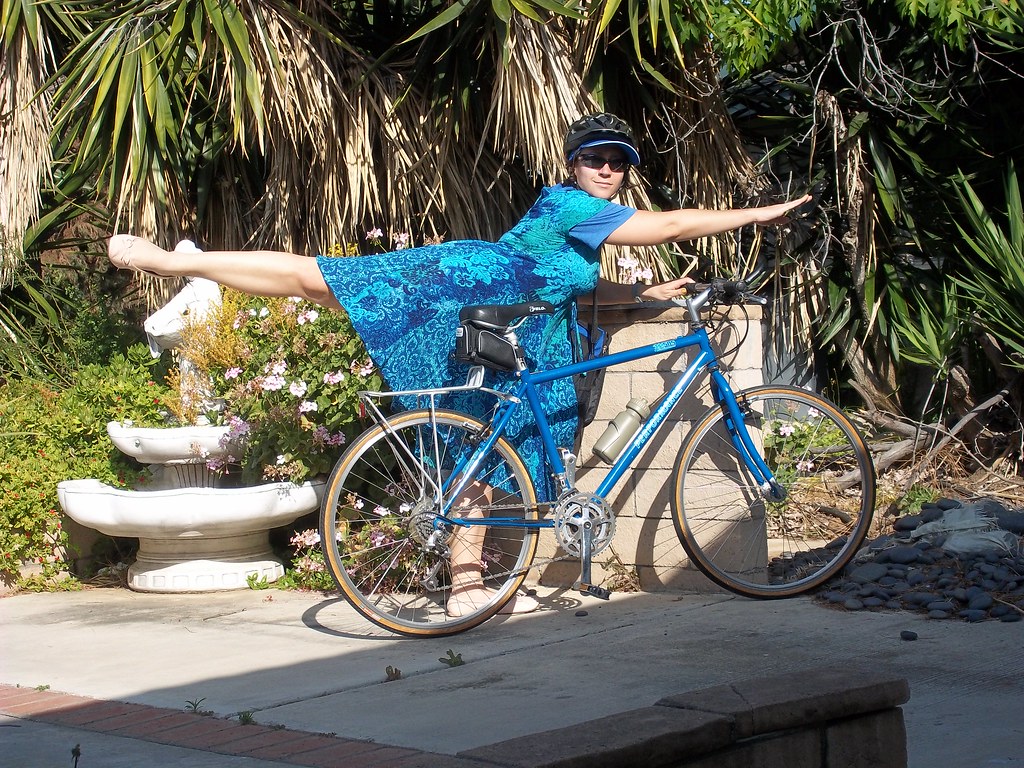
If you've never had a milk crate on your bike rack, you are missing out on one of the most versatile ways to haul a diverse array of items. I will present some of the most compelling reasons here. Invest in yourself to celebrate Bike Month and consider adding a milk crate to your commuting setup. It's more affordable than a set of the cheapest panniers.
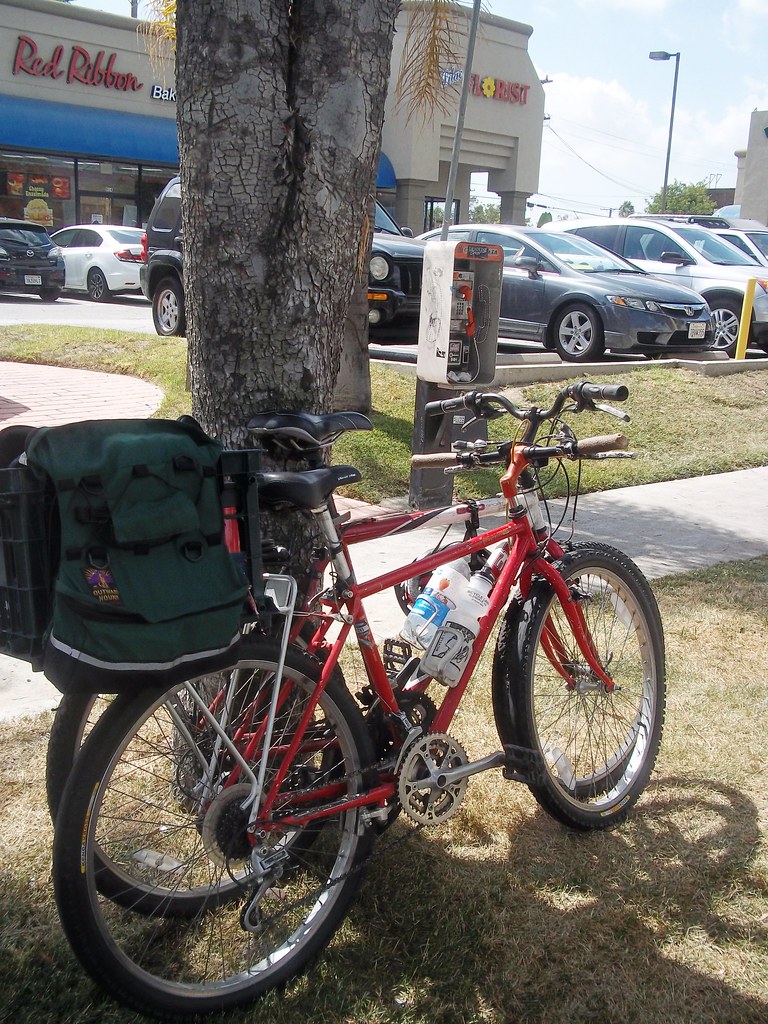
You can find a milk crate in the office supply store, hardware store, or superstore in the home organization section. Or better yet, find one in the trash to upcycle. I've had 3 different milk crates on bikes in my life (in the past 20 years). Sometimes people attempt to steal or vandalize your milk crate, and sometimes the plastic just wears out. Mount it securely to your rack with nuts & bolts. Carry an adjustable wrench and screwdriver to tighten the mounting hardware if it gets loose.
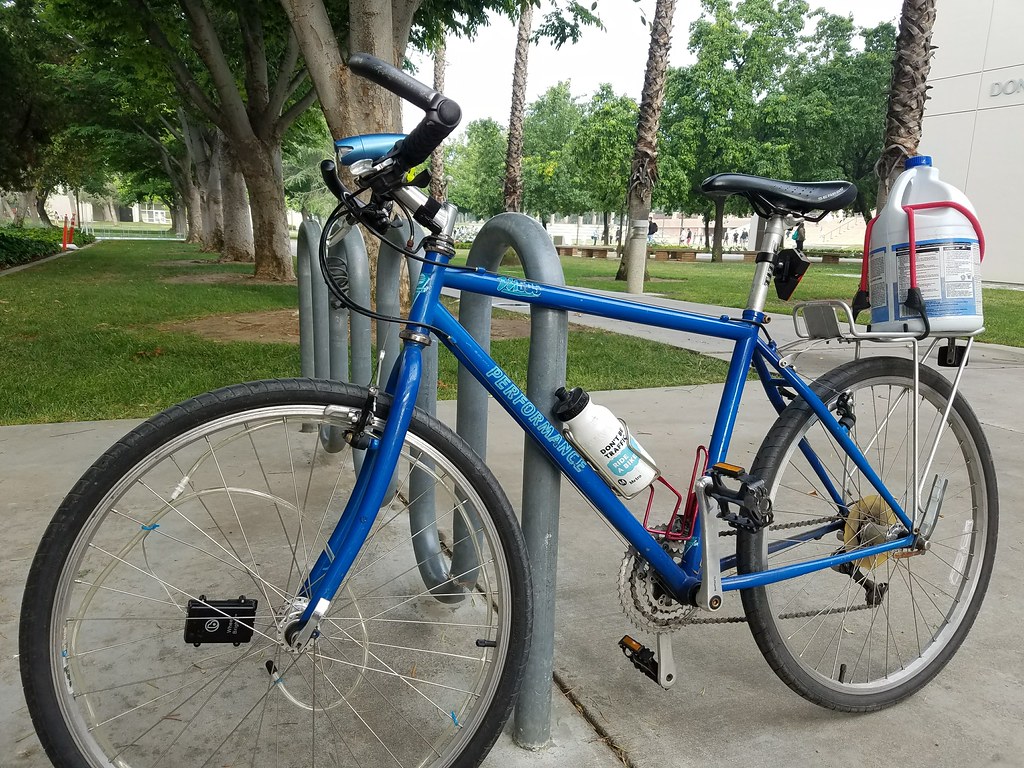
1. Hazardous Materials - Pictured here is a jug of bleach bungeed onto my rear rack. It would have been safer in a milk crate. I could see this would also be a safer way to transport paint. Anything you wouldn't want to spill or explode in a pannier. A milk crate can be easily detached and rinsed out in the event of a leak. If the milk crate gets ruined, you can buy another for less than $10.
May 5, 2017
2. Bags - Pictured here is my typical backpack (containing a computer) and a dog-hiking saddlebag turned into a bicycle toolbag. The milk crate offers various positions for your bungee hooks, so it's easy to keep everything tight and secure. You can put all shapes and sizes of bags into the milk crate, make an 'x' of bungees across the top and go!
November 18, 2010
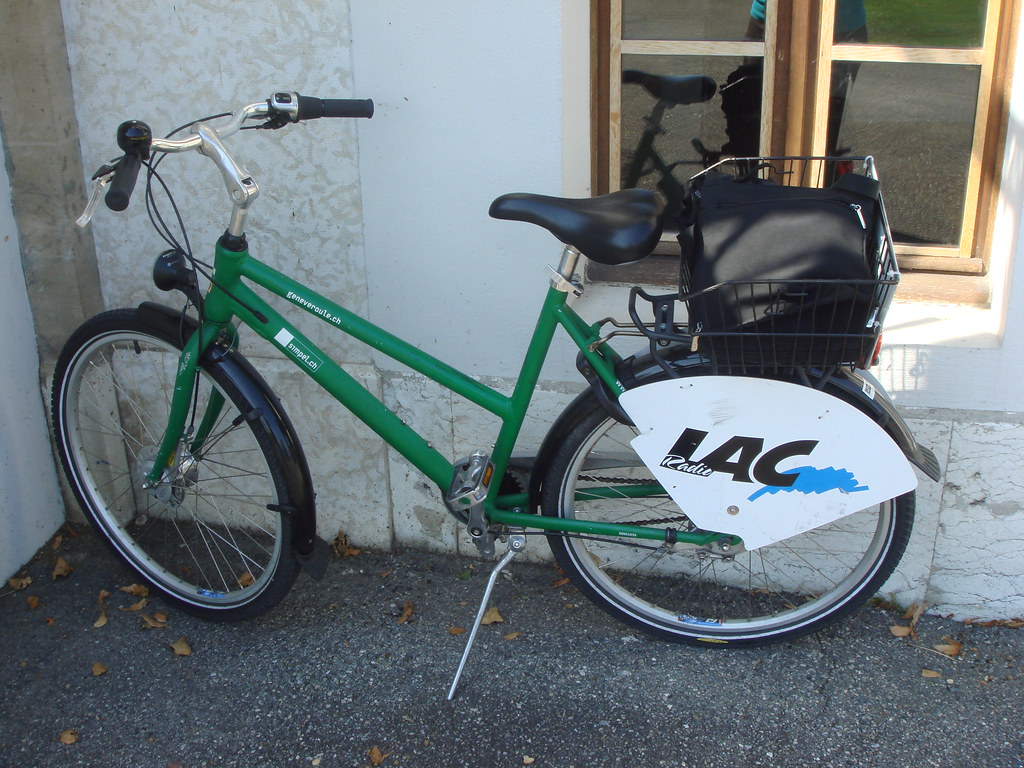
3. Water - If you don't have a water bottle cage, a milk crate is a great place to store your water. This was a bikeshare bike that I rode from Geneva, Switzerland to Evian, France.
September 14, 2007
4. Cakes - I transported numerous cakes from my house to school in an upside-down Tupperware container (so the lid supports the bottom of the cake). You wouldn't put that in a pannier, since it could tip over, but a milk crate is perfectly level.
July 31, 2008
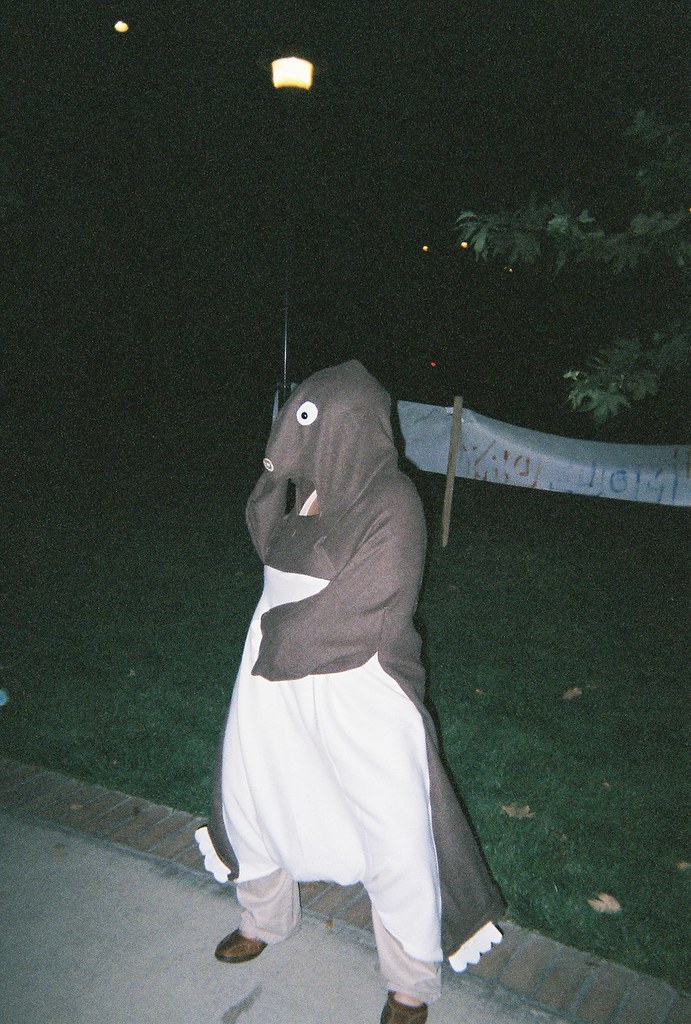
5. Costumes - This is a mole costume which requires a bicycle helmet under the 'hood' part of the head. Celebrating 'mole day' is a thing chemists do periodically. It's really fun to arrive at a party with your costume (and several cases of beer) in a milk crate.
October 23, 2008
6. Rocks - If you're into geology, a milk crate is a great way to bring back rock samples. You wouldn't want them weighing you down in a backpack. And you also wouldn't want them to get your bags dirty.
February 15, 2009
7. Plants - Maybe you're not into inorganic (rocks) but you're more of a biologist... it's really awesome to transport plants in a milk crate. Here, I'm showing a flat of Arabidopsis on my rear rack but it would really have been better to have the plants in a milk crate in case the bike tilted left or right too far.
September 15, 2009
8. Ice Cream - The last thing you want is melted ice cream in your saddlebag. It's much better to have an insulated bag in your milk crate, then pedal at top speed to get that frozen treat home before it melts. In Germany, I did all my shopping by bicycle. I would buy frozen fish fillets regularly.
December 29, 2009
9. Locks - it's no problem to bring your U-Locks if you can toss them into your milk crate. That way you can secure your bikes while you enjoy your destination.
January 1, 2010
10. Maps - There's nothing less safe than looking like a tourist. Some people go around on bicycle tours with a cue-sheet, remarking on ooh! and aah! and ooh-la-la! When I'm in a foreign country, I try to blend in as much as possible. Keeping the maps on the down-low and only discreetly peeking at them to plan your next segment on a trip to the restroom (in full privacy) ensures that you don't become a target of pickpockets. In Italy, I stayed at several hostels and heard horror stories of travelers who had lost money, passports, phones, and other important travel documents. If you keep your maps in a milk crate, you'll think twice before pulling them out in public.
June 26, 2010
11. Take-Out - Imagine hot liquids, such as Phở or Sweet-and-Sour Pork. You wouldn't want to risk that spilling in your saddlebags! A milk crate is the perfect way to pick-up your to-go foods.
July 19, 2010
12. Farmer's Market - Because the seasons change, you never know what you'll find at the Farmer's Market. It's so much safer to transport items such as plums and tomatoes in a milk crate because if they're ripe, the skin can break, releasing sticky sweet juices that could be hard to get out of your panniers. I like how there are all ages of people in this photo. It's not only for the young and fit to use a bicycle as a primary means of transportation.
August 28, 2010
13. Workout Gear - Imagine sweaty socks, ballet slippers, swimsuits, wetsuits, anything that would stink up your panniers or carry a good amount of sand and surf. Those items lend themselves perfectly to a milk crate on the back of your bicycle. You could also bungee your yoga mat directly to the milk crate.
May 27, 2011
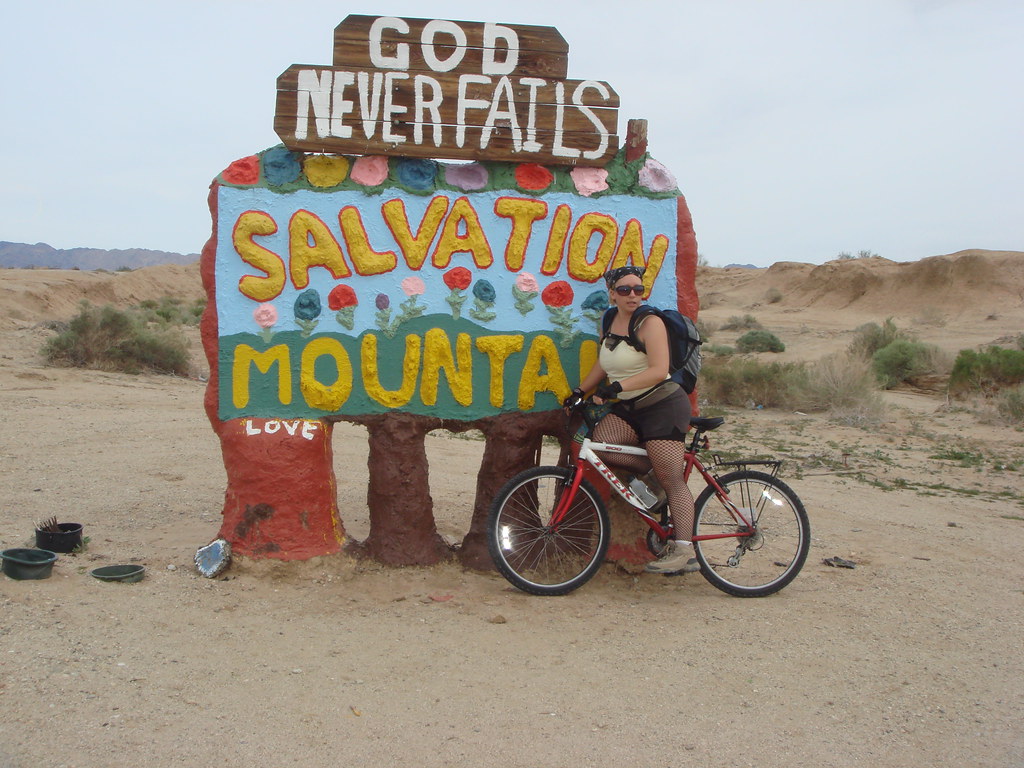
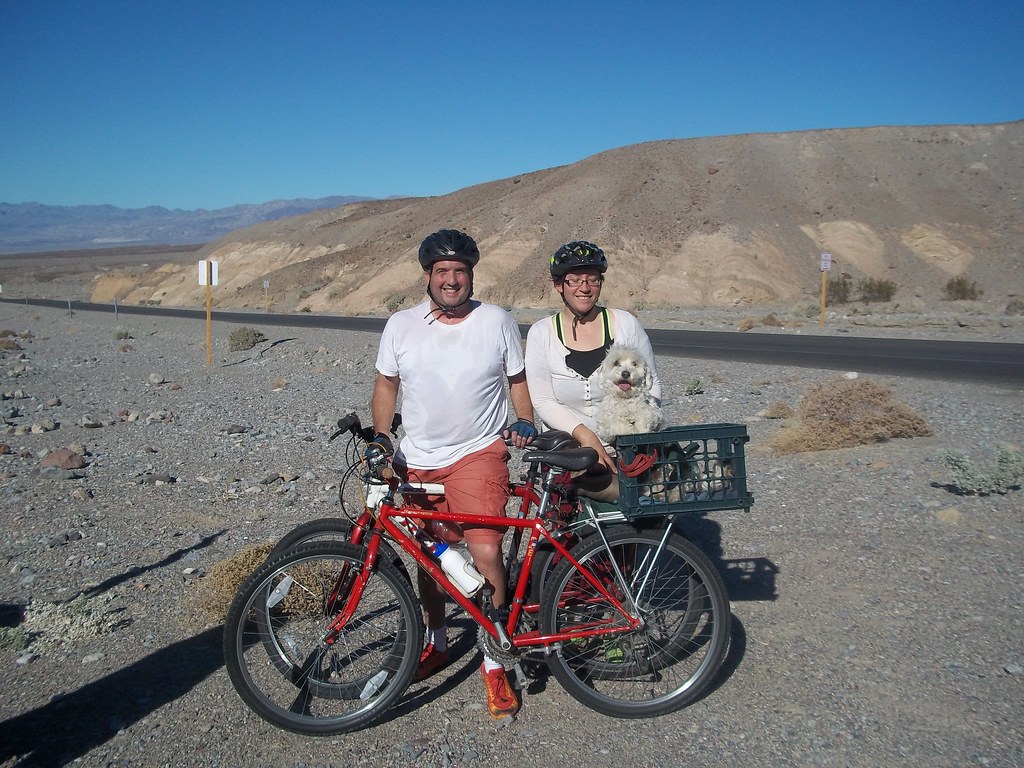
13. Dog - Our dog didn't love riding behind me in a milk crate, but I've seen other dogs quite content to do so. We would employ the harness that came with our 'dog hiking backpack' which resembled a kind of strait jacket to keep her from jumping out. This was a 30 mile bike ride in Death Valley.
December 23, 2014
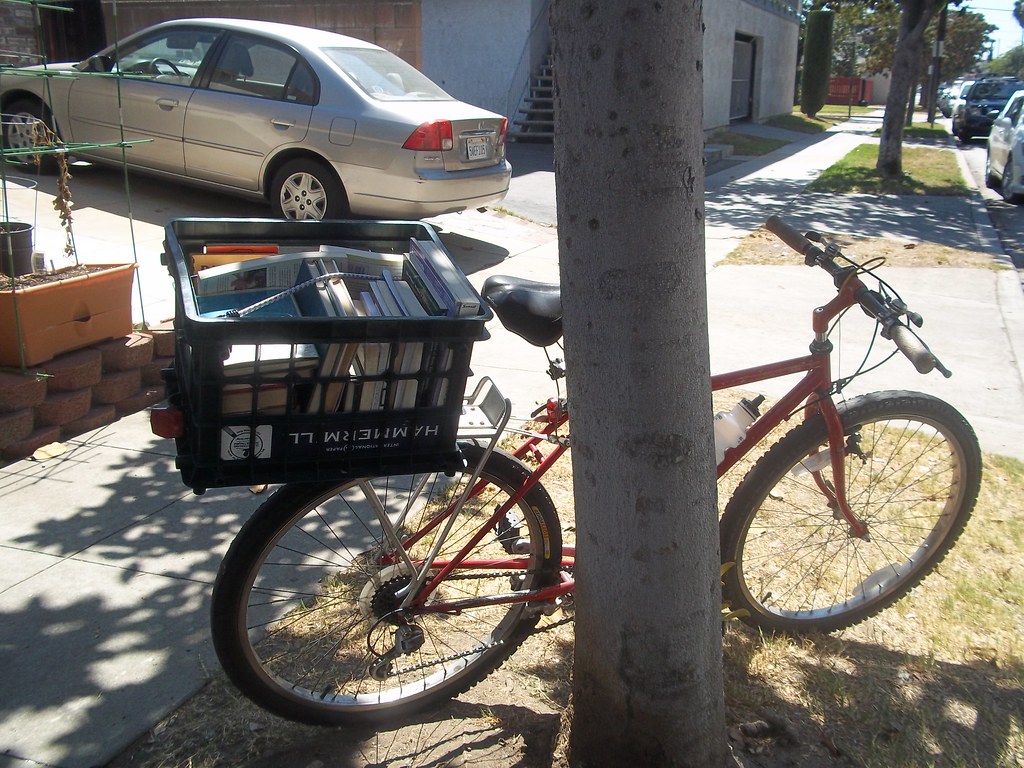
14. Books - The best way to get stronger legs is to put your heaviest books in your milk crate and bomb some hills. I used to put Chemistry, Calculus, and Biology, top it with a bungee and then head out. This photo is from when a bookstore was closing and we took home a big haul of books!
September 14, 2014
15. Sound System - I've never done this, but I know lots of people who do for open street events like CicLAvia. You don't have to abandon your tunes when you get out of your car. There is plenty of space in a milk crate to set up speakers loud enough to share with a group of your friends.
October 24, 2014
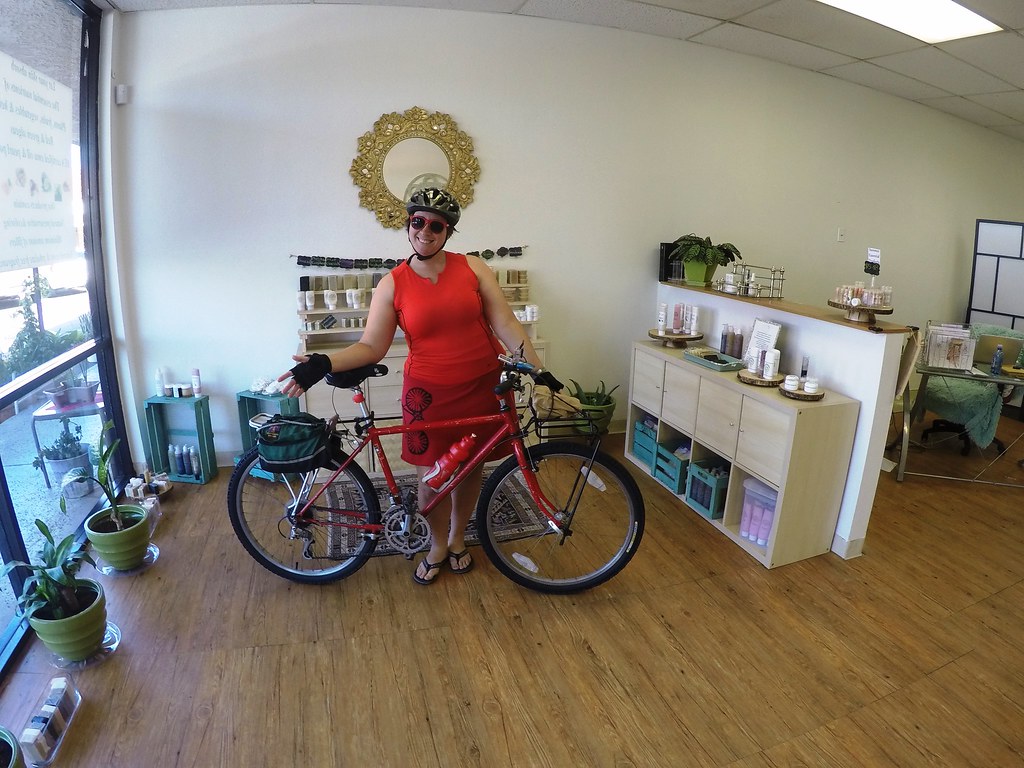
17. Cosmetics - I buy cosmetics regularly from CT Organics. You don't want to put those oily lotions, soaps, and creams into a bag that you also have your cell phone in. Especially if you have a long, hot ride back to The Valley from Santa Clarita. Throw them in a milk crate and you can be sure that your electronics can be well-segregated from the essential oils. Speaking of which, SHOUTOUT to the Mother's Day Boutique, which is TODAY.
18. Coffee - Instead of buying coffee at school, I'd take about 6 Cups of drip-coffee in a Hydroflask and bungee that to the inside of my milk crate. Then I would put the half-and-half in a 700 mL water bottle with a coozy around it. I could refill my travel coffee mug (in the water bottle cage) at will during my commute on the Metrolink train. It is a glamorous way to travel!
October 20, 2014
19. First-Aid Kit - If you're spending all day in the sun with the family, your adorable nephew may end up with a skinned knee. This day, his pedal was threaded backwards and consequently fell off three times, each time our nephew fell to the ground and skinned his knee. If we had been carrying more tools and a first aid kit (and a picnic lunch) in a milk crate this family day wouldn't have had to be cut short.
April 7, 2012
20. Pizza - Who doesn't love pizza? An easy way to deliver your own pizza is to bungee the pizzas right on the top of your milk crate. It's already a flat surface. You can put the drinks, dipping sauces and breadsticks in the milk crate and the pizzas form an automatic lid. That's what we did this day!
September 27, 2014
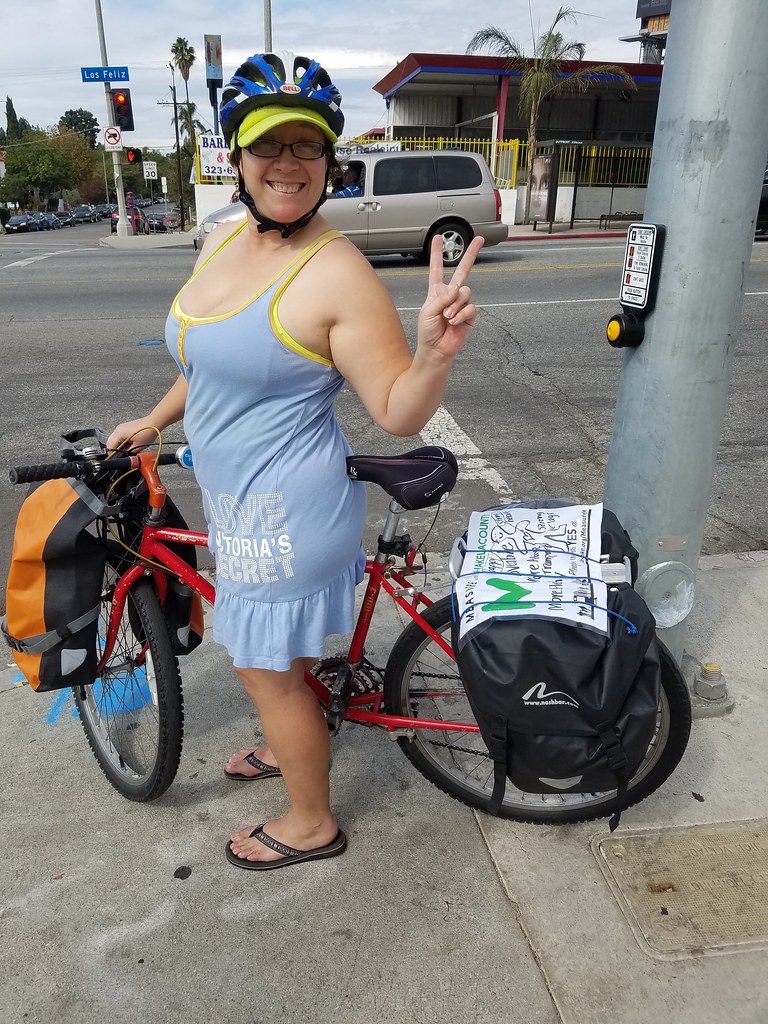
21. Campaign Signs - Although I had a good time doing some last-minute campaigning for the passage of Measure M, this sign would have been more effective on the sides and back of a milk crate. Think of the milk crate as advertising real estate.
October 23, 2016
22. Firewood - Our bicycle camping trip was fantastic. I had to ride several miles to the Albertson's to buy firewood and it would have been convenient to put the bundle of wood in my milk crate. Instead, I bungeed one bundle to the front rack and one bundle to the rear rack, which was OK, but that's another thing you wouldn't put in a pannier.
December 29, 2015
23. Teaching Supplies - In this photo, you can see I fitted my milk crate with a custom-trimmed paper box lid to make it somewhat padded and also have fewer holes. I brought everything I needed to do my job in this milk crate for years. Candy, cookies, molecular and solid state modeling kits... anything somewhat fragile that wouldn't do well banging around in a backpack is ideal to be transported in a milk crate.
In closing, I will offer a word of caution. The high center of mass created when you fill your milk crate will change the dynamics of stopping, starting, turning, and overall handling of your bicycle. Make sure your brakes are in working order (read: tight). If you are riding with a group, remember that a fully loaded milk crate will alter your stopping distance (because you have more momentum).
If you find that a milk crate makes your bike too difficult to handle, panniers will be better since they have a lower center of mass. I have more trouble with weight on the front of my bicycle than the back. Front baskets are good so that you can see what's going on, but when you let go of the handlebars, the front wheel will turn rapidly so that the load has the lowest potential energy.
If your weight is in the rear, however, and you are stopped at a red light, simply use your legs to stabilize the bicycle frame. Take care when not moving to stabilize the bicycle. You may want to investigate in a heavy-duty two-legged kickstand if that's important to you, but I've always found a bike rack or tree nearby to prop the bike against.
Share your thoughts, suggestions, experiences and comments! HAPPY BIKE MONTH!!!!!!