Showing posts with label Hollywood. Show all posts

Monday, November 18, 2019

Pregnancy Part 14

This weekend we worked on our house tasks and took a day in LA. Last weekend, we did some shopping, then more shopping, then house tasks. What I mean by house tasks is furniture assembly and redistribution of items into the new furniture.


When we moved to our Northridge condo around 2.75 years ago, we agreed that we wouldn't buy any furniture or decorate until we had lived there for 1 year. After that time, we bought a few bookshelves, a pair of lamps and some end tables. Nothing too expensive, since we live across the street from the Goodwill. Maybe all together it cost $200 (or less). It doesn't look bad, in fact we were so overjoyed to have the extra space and white walls.

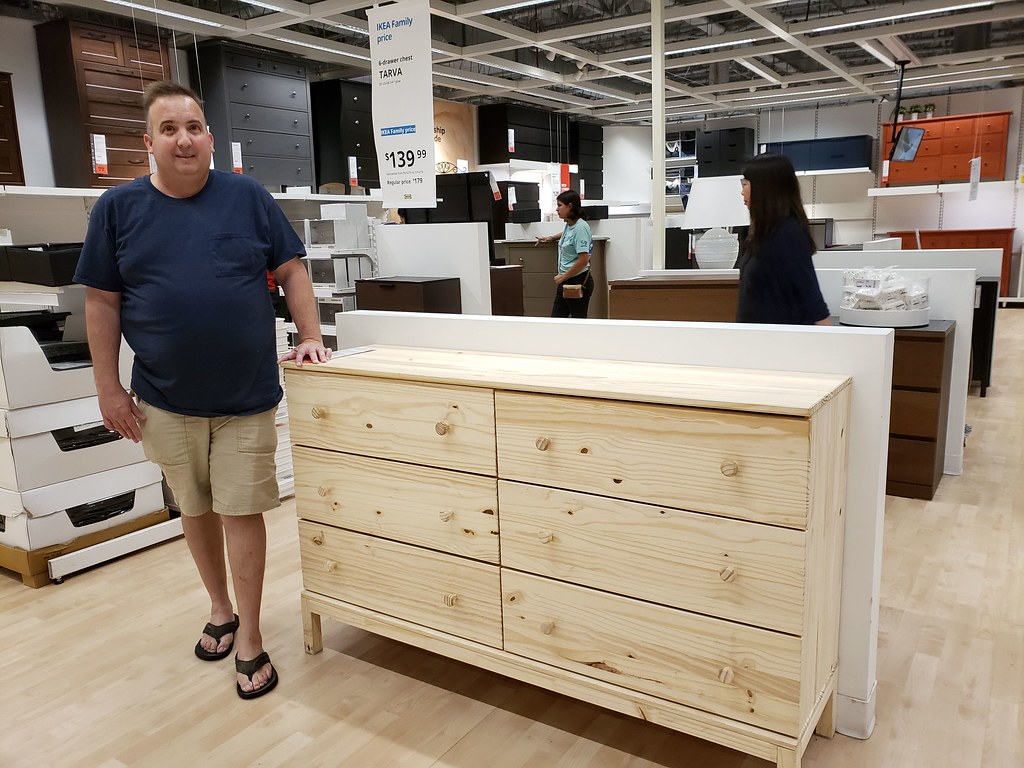
Now, we are preparing to babyproof the house, which means getting everything up off the floor and into containers that the baby can't get into. Hence the need for furniture. We bought two dressers at IKEA which have 6 drawers each. The space we were concerned about was a metal shelf that had everything exposed.

Xmas 2017 / New Year 2018
I don't know if you can tell, but the dry goods in the metal rack above are organized by plant family. Other items moved into the new dressers included: glassware, tablecloth, fabric napkins, dishrags, aprons. And my seed library!


View this post on Instagram

A post shared by Kayla Kaiser (@hamerk02) on

The day in LA was fun and we did a lot of walking. Seeing the Walk of Fame is always an eventful day. We saw a movie at the Cinedome (56 years old) on Sunset and Vine, which is now called the ArcLight Hollywood. We ate lunch at Miceli's (a 70-year institution on Hollywood Blvd). I did wear my BellyBandit belt for a few hours in the morning, but I took it off at lunch. It was fun showing my in-laws how to ride the subway (Metro) red line.

I wish I had time to write more, but tonight we have a doctor's appointment and then Bradley birth class and then I am DETERMINED to get to the grocery store and get re-stocked. We've been eating out quite a bit since devoting our weekends to "home tasks" instead of grocery shopping and cooking.

Saturday, October 29, 2016

MultiModal Weekend (Part I)

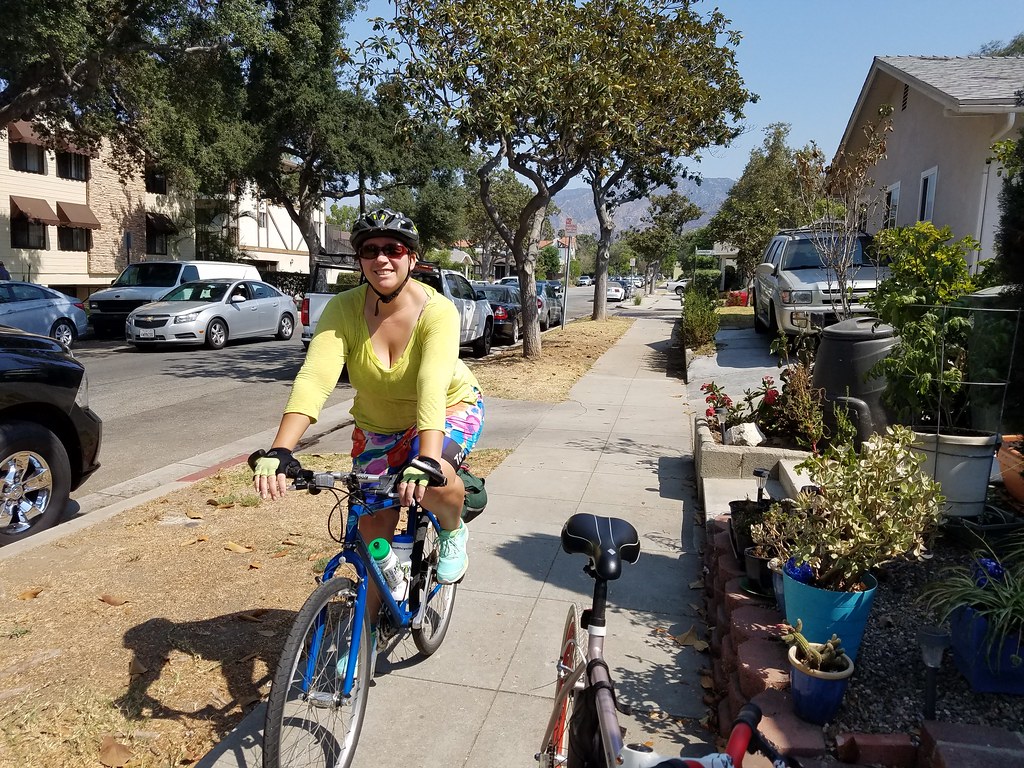
The weekend of October 14-16th was a big experiment for me.  I used bike, bus, car and train to get around LA County.  I have been wanting to write about the experience and compare each way of getting to and from downtown Los Angeles for a resident of Glendale.

https://www.strava.com/activities/744729565
Friday, October 14th, after work I left California State University, Northridge around 2pm.  I rode along the Orange Line Busway Bike Path.  I rarely ride at this time, but there were lots of school-age teenagers walking on the sidewalks of Reseda and Van Nuys.  I got a little bored in NoHo, but that's normal.  It's not that fun riding in the bike lane along Chandler Blvd, especially when there aren't any other cyclists out there to chase.  After cutting down Keystone, I took an unplanned left turn on Alameda, which had a pretty nice bike lane (that I'm not seeing on Google Maps).  The video below shows it at 53 seconds in.


I went down Victory Blvd to a little side street called Ruberta, which used to have a cool "Halloween House" but now it doesn't.  I refilled my water bottles in the drinking fountain at the Glendale Narrows, then rode/pushed/carried my bike across the Bette Davis Picnic Area (Cyclocross training) and up to Riverside Dr to gawk at the closure of the Los Angeles River Path.  

The Army Corps of Engineers will be hosting a public meeting on Monday, November 7th, from 6:30 p.m. – 8:30 p.m. at the Friendship Auditorium by Griffith Park (3201 Riverside Drive) and LACBC encourages all to attend and speak up.

All that being said, I took the detour through Griffith Park and entered the bike path by the dog park. I exited the path at Fletcher and took the route through Silver Lake and along Sunset Blvd to reach Spring St. I don't know why other people don't like going that way. It was also the first time I really didn't need a route sheet. That's what I love about CicLAvia, it makes me understand how to reach downtown LA without a car.

Raw crunchy four kale mix, shredded cabbage, apples, shredded carrots and avocado, grape tomato, tossed w/ maple orange dressing, topped w/ currants, hemp seeds & creamy hummus dressing drizzle 

After reaching LACBC headquarters, I had dinner at the LA Cafe.  I don't know if it was the 2 hours and 40 minutes I'd just spent winding my way gradually from The Valley to Downtown LA, or if the salad was REALLY GREAT but I haven't had a better meal in years.  There were picnic tables in a parklet, a couple of nice bike racks to lock up.  It was the ideal way to wind down from my ride and take in a street view of the city.

Now I'm off to make the City of Glendale more walkable.  I'll have to finish this post in a multi-part series.

Sunday, July 31, 2016

smog > smug


This summer, I've been driving to work.  I hate it.  I realized that when I bike to work, I feel smug about it because I feel like I am personally improving the air quality.

With the current wildfires in Santa Clarita, there is a considerable amount of particulate matter in the air.  Several biking events (626 Golden Streets, the Tour de Laemmle) have been postponed due to poor air quality.  It's one thing to blame the air quality on wildfires, but the truth is that there are many things we all do on a day-to-day basis that generate particulate matter.

Particulate matter affects human health, leading to asthma and chronic bronchitis.  Sources of particulate matter that we can eliminate include: agricultural (leafblowers) or construction activities which liberate mineral dust, combustion of fossil fuels and biofuels, electricity generation (via coal and natural gas).

Smog is visible air pollution made up of NOx, SOx, ozone, smoke or particulates.  The air quality in Los Angeles County is pretty bad year-round but we really notice it when we can see how bad it is. Lately, all you need to do is look up in the sky.  Angelinos have been asking each other, "are those clouds or just smoke?"

Surprisingly, two sources of indoor particulates are hair dryers and curling irons.  Our vanity might be making us sick.  I had heard that clothing dryers were a major source of particulates in the home, but it turns out that hair dryers and curling irons are 17 times worse than a clothes dryer.  The other major source of indoor particulates is cooking.  Spending time in a restaurant is almost 7 times worse than sitting in traffic on the freeway.

Yesterday we had the great opportunity to attend LA Rooted Youth Organizer Led Art Exhibit: Movement for the Earth.  It really got me thinking about how to: Masticate, rely on Ancestral wisdom, be Intentional, and aim for Zero-waste (MAIZ).  We had a great time biking to the event and the themes presented by the youth really resonated with me.

When possible, I will get back to biking to work.  And I'll try to be less smug about it.

Friday, April 1, 2016

It's all happening at once!

So many great things are happening, it seems impossible to keep up.

Walk Bike Glendale is planning a series of events:

Verdugo Mtn 10k Training Hike https://www.facebook.com/events/870265023086202/

Women's Beginner Rides https://www.facebook.com/events/254030184935096/

Family Ride https://www.facebook.com/events/1077360075660632/

Commuter Workshops https://docs.google.com/document/d/1GaD-3cPUxq8As_Tu0oVfmz_UsRulLT7jp3R-HQ0JDi0/edit?usp=sharing

Commuter Workshop Class #1 = Tuesday, May 10 from 7-9pm
https://www.facebook.com/events/1002405029796451/

Commuter Workshop Class #2 = Thursday, May 12 from 7-9pm
https://www.facebook.com/events/584312521744875/

Commuter Workshop Ride #1 = Sunday, May 15 at 7:30am
https://www.facebook.com/events/1730956240481600/

Commuter Workshop Ride #2 = Saturday, May 21 at 10:00am
https://www.facebook.com/events/464855407056862/

Saturday, January 23, 2016

Griffith Park Traffic Plan Presentation

The presentation hinged on four points:

1) public safety
2) shuttle
3) Hollywood sign
4) media campaign

The intersection of Vermont and Western Canyon was heavily impacted during Spring Break.  They propose one-way traffic on Vermont and two-way traffic on Western.  A shuttle would stop at Traveltown, the LA Zoo, connecting to the Metro Red Line at the Sunset & Vermont station.

There will be free parking at the Greek Theater and Section 9.  East & West Observatory Road will have angled parking (metered).  The goal is to redirect tourists who wish to view the Hollywood sign from the neighborhoods to the park.

The shuttle route would be from the Greek Theater to the Obsevatory.  Another shuttle would run from the Greek Theater to a Hollywood sign viewpoint.  A third shuttle would run through the tunnel and back.  Shuttle service would run every 15-20 minutes.

Vehicle traffic invading Vermont and Ferndale would be alleviated.  Hollywood & Western may be designated as the official Hollywood sign viewing point from the Metro system.  There will be shuttle stops outside the park.

Q & A session:

Q. Will Western Canyon eventually become a one-way street?
A. Eventually, but not in phase 1.  Phase 1 will roll out in Fall 2016.

Q. Can you give us more details about the shuttles?
A. They will hold 21 passengers.  There will be 4-5 shuttles total.

Q. What about the sharrows along Obsevatory Road?  Sharrows do not work to improve public safety.  Impatient motorists passing cyclists can cause problems.
SEE: http://bikinginla.com/2013/07/24/embarrassing-video-shows-sheriffs-deputy-doesnt-know-what-a-sharrow-means/

Q. What about the environmental impact of the shuttles?
A. The mitigated negative declaration tells how much emissions the shuttles will generate annually.  The document is available on LAparks.org.

Q. How does the neighborhood traffic exit Commonwealth Canyon Drive?  Residents cannot get to their houses, nor can emergency vehicles access those residents.

Q. Why can't Griffith Park be closed to all cars like Central Park in NYC?
A. We are reaching saturation of cars within the park, so this may be a long-term solution.

Q. Has a bike lane been introduced to the one-way plan?

Q. Can revenue generated by parking fees be used to repave Mt. Hollywood Dr. and keep it closed for pedestrians and cyclists?

Parting thoughts:

The shuttle in Zion National Park is a buzzkill for pedestrians and cyclists.  The selfie culture is dominating wilderness access.

Griffith Park is my Backyard, Too (Mapped on 12/21/2015)

After thoughts:

During public comment, I spoke about how I was among the dreaded Spring Breakers, although it was 15 years ago.  At that time, websites were sparse.  Back then, I found information about the Youth Hostels we stayed at on a webpage, but most of our information was found in travel books and magazines.

As a tourist, I would not have had the sophistocation to take public transportation back in 2001.  Coming from Nebraska, I had no idea how to navigate the Metro light rail system.  I have lived in California for more than 10 years now, and I am just now figuring it out.

This is a scan of the actual scrapbook.
In order to take our photos in front of the Hollywood sign, we drove around the area until we found some neighborhood to park in and hike up a bit.  Some nice locals even took our picture.  I want to say that our "tourist dollars" poured into California, but the truth was that we didn't actually go inside Legoland or Disneyland.  We did a lot of walking in areas that were free.


What I didn't realize at the time is that I was already imagining what it would be like to live in Southern California.  I love the sunshine and recreational opportunities that come with it.  Speaking with a former running buddy, I describe how the streets of Glendale are a dangerous place to go running, but Griffith Park is considered a safe space.  Also, the climbing offered by Griffith Park, in particular Mt. Hollywood Dr. (currently not open to cars), is a great way to train for other longer rides that involve hills.  If I only ride out to CSUN and back, it's too flat to prepare for hills.  


Having a safe space to climb on a bike is EXTREMELY important to those who train for the long multi-day rides such as Aids/Lifecycle, the Climate Ride, and Ride2Recovery California Challenge.


With all the negativity (on the part of cyclists) about sharrows, I did a bit of reading.  It turns out that sharrows are meant to show cyclists the safest place to ride.  I had been confused when there are sharrows in the middle of the lane, I ride in the middle of the lane.  I thought there were no sharrows in Glendale painted to the right of the lane, but here's one example.

Watch this video here.
When a sharrow is painted in the center of the lane, it means that riding to the right side of the lane is not safe, due to parked cars (creating a door zone) for example.

If you really want to read the entire report regarding "Griffith Park Action Plan" as it is called, see here:

If I, as a cyclist, had to do 2 hours worth of research and reading to really understand a "sharrow" it's unlikely that people will use them as intended.


SF to Salinas Century (May 2015)
The other thing, that I think is related to these issues, is a discussion of requiring cyclists to have safety flags and wear a certain amount of square inches of fluorescent fabric.
I have no problem wearing fluorescent colors and reflectors and I have a flag for my bicycle that I use when I'm volunteering as a ride marshal or when I ride recreationally along the Pacific Coast Highway.  I wonder if the Park Action Planners realize that opening Mt. Hollywood Dr. to cars will force cyclists like me to start worrying about my safety.  I already worry enough as it is, can't we just have one car-free space to train?  

When I ride among cars, I will wear a safety vest and if on a particularly busy highway, I will fly my flag.  I don't want to have to do all that to ride in my "backyard," aka Griffith Park.


I understand that a helmet is expensive. The safety vest I wear was $15.  I think we paid $12-15 for our flag at a bike shop, but you can buy a 6' flag online for $7. Some helmets cost $60-120 and some are as cheap as $7 (see Burbank Bike Angels).  I have heard that a mandatory helmet law for cyclists is not supported by bicycle advocates due to the cost burden for low-income individuals that rely on a bicycle as their primary means of transportation.  What about the requirements for reflectors ($8)?  Are they not cost-prohibitive?   The lights I use are in a state of constant flux, but $26 was just for a USB-rechargable taillight.  A set of front and rear lights was $39 (in 2013).  Half of our fleet of bicycles is missing the pedal reflectors ($5).  So just to meet the current laws would cost just over $50.  Adding requirements for a helmet, vest, and flag would bloat the cost for the casual cyclist, commuter, or competitive athlete.

The bottom line for me, that I didn't get to articulate in my 1 minute public comment, is that Griffith Park should NOT be open to shuttles or car traffic. #keepgriffithwild

Friday, September 11, 2015

Go Metro

Metro operates four light rail lines (Blue, Green, Gold and Expo). Light rail is similar to a tram, it may operate on or parallel to surface streets, but with a right-of-way.  Metrolink/Amtrak trains are: larger, travel longer distances, have a lower frequency of service, and connect suburbs with urban centers.  Metro light rail trains cover the more urban areas, operate more frequently, have a greater number of stops, and if you are traveling with a bicycle you must stand with it.

My previous post was mainly centered around commuter rail lines (Amtrak/Metrolink/COASTER).  A map of the activities I listed there is shown below, and linked here.

State/National Park Destinations via Commuter Rail
I absolutely love the guide Metro has put together of things to do at (or near) its stations http://media.metro.net/docs/metro_destinations_guide.pdf 
The only thing is that many of the destinations marked on there are for shopping or have high cost of admission.

Ideas for Bicycle/Pedestrian Tourism

(1) Lake Balboa (6300 Balboa Bl) is off the Balboa stop on the Orange Line, which is actually a bus.  Riding a bike all the way there is possible, but the subway (red line) to the NoHo station and bus (orange line) to Balboa is also possible.  Maybe we could ride public transportation one way and ride bikes back.

(2) LA County Arboretum (301 North Baldwin Ave, Arcadia, CA 91007) is off the Gold line at Sierra Madre Villa.  A 2 mile walk East on Foothill Blvd. then South on Baldwin Ave will get you there.  Adults are $9, students with ID are $6.

(3) Norton Simon Museum (411 W Colorado Bl) is off the Gold line at Memorial Park. Less than 1 mile West on Colorado Blvd and $12 will get you in. Admission is free for all visitors the first Friday of every month from 5:00 to 8:00 p.m.

There is a cool exhibit at the museum right now that echoes the theme of "National Chemistry Week"
it's called "A Revolution of the Palette" and shows how chemists created colors for artists
The exhibit is on display through January 4th, 2016
(4) Old LA Farmer's Market (every Tuesday from 3PM to 7PM) is off the Gold line at Highland Park. Barbeque pits are available at Sycamore Grove Park (6150 Piedmont Ave., Los Angeles, CA 90042).

(5) Historic Downtown Farmer's Market (every Sunday from 9am-2pm) 2 blocks from the Pershing Square station on the Red or Purple line.

(6) Grand Park Farmer's Market (Tuesday from 10am - 2pm) off the Civic Center station of the Red or Purple line.

(7) Hollywood Farmer's Market (Sunday from 8am-1pm) off the Red Line station at Hollywood/Vine.

(8) Central Avenue Farmer's Market (Thursday from 10am-3pm) off the Blue line at Vernon.  Walk West on Vernon to North 2 blocks on Central.
The "National Chemisty Week" theme also deals with the chemistry of natural pigments in foods
(9) Barnsdall Farmer's Market (Monday from 11am-4pm) off the Red line at Vermont/Sunset.  Walk NorthWest to the Barnsdall Art Park.

(10) Watts Healthy Farmer's Market (Saturday from 10am-2pm) is West from the 103rd Street/Watts Towers station of the Blue line.

(11) Mar Vista Farmer's Market (Sundays from 9am-2pm) Grand View at Venice Blvd.  Take the Expo line to Culver City, ride toward the beach (downhill) on Venice Blvd. Market will be on your left. Culver West Alexander Park (4162 Wade St, Los Angeles, CA 90066) has 3 barbeque grills.

(12) The Grove Farmer's Market (6333 W.3rd St. Los Angeles, CA 90036) has Pan Pacific Park nearby, which has BBQ pits. Taking the Purple line to Wilshire/Western and biking North on Western, West on 4th St, North on S Cochran Ave, and West on 3rd St will get you there.  The Grove is open 7 days a week.

Destinations via Bus, Bike & Light Rail
(13) Glassell Park Farmer's Market (3150 North San Fernando Road, Los Angeles, CA 90065) is on Saturdays from 10am-3pm at the Goodwill Community Enrichment Center. There is a pretty big park called Ernest E. Debs Regional Park (4235 Monterey Rd, Los Angeles, CA 90032) that has barbeque pits.  From the Glendale Metrolink, you would go down San Fernando Rd and take Eagle Rock Blvd to York Blvd.  Then Ave 50/52 South towards the park entrance.

(14) Burbank Farmer's Market (N 3rd St & E Orange Grove Ave, Burbank, CA 91502) is Saturdays from 8am-12:30pm.

(15) Toluca Lake Farmer's Market (4500 Sancola Ave, Toluca Lake, CA 91602) is open Sunday from 9:30am-2:30pm.

(16) Echo Park Farmer's Market (1125 Logan St, Los Angeles, CA 90026) is Fridays from 3pm-7pm.

(17) Glendale Farmer's Market (Chess Park, 227 N. Brand Blvd., Glendale, CA 91203) Thursdays from 2-7pm.

(18) South Pasadena Farmer's Market (Meridian Ave & El Centro St, Pasadena, CA 91101) off the Gold line at South Pasadena Station. Open Summer Hours Thursday 4-8pm.

Burbank Farmer's Market
(19) Old Pasadena Farmer's Market (E Holly St at Fair Oaks Ave, Pasadena, CA 91103) on Sundays from 9am-2pm. Accessible from the Gold line Memorial Park Station.

(20) Montrose Harvest (2300 Honolulu Avenue at Ocean View Boulevard) Sunday from 9am-2pm.

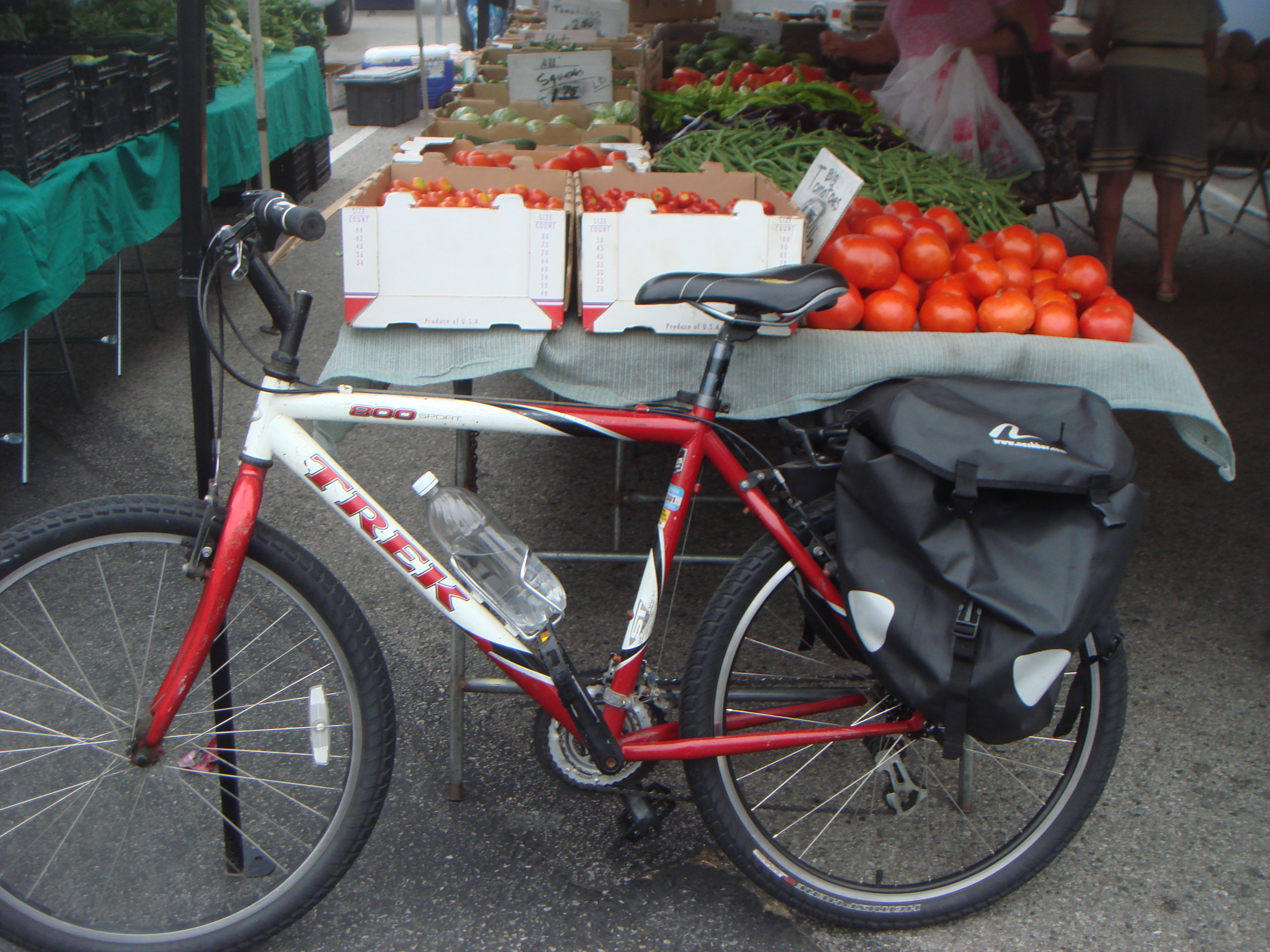
One of our crazy ideas is to take people to a farmer's market to buy produce.  Then we could find a park and set up a camping stove or use publicly available outdoor BBQ grills.  We would have a picnic/cookout with the items purchased at the Farmer's Market.  All of this could be accomplished using public transportation together with bicycles!


National Chemistry Week (NCW) is celebrated the week of Mole Day (10/23/15)

Monday, August 31, 2015

Metro's Active Transportation Plan needs your input!

Good advice lasts.  I remember hearing a talk in November of 2008 entitled "Leading Professional and Institutional Change through Subversion, Revolution and Meterology."  The speaker was Debra R. Rolison of the U. S. Naval Research Laboratory. She told us about the Rule of 18, which states that when you take a new research direction, it will take 18 months to get yourself up to speed in the [new] area.

Last week I attended an Open House Workshop about active transportation in the San Fernando Valley. I didn't study transportation planning or urban design in school, so it has taken some time to learn the ins and outs of the transit system here in Southern California.  I will try to explain some of the basics here so that you can take part in the conversation, too.

Metro is the major operator of bus and rail service in Los Angeles County, California.  Metro hosted the first round of Open House Workshops as part of the development of the Active Transportation Strategic Plan.  Active transportation refers to any form of human-powered transportation – walking, cycling, using a wheelchair, in-line skating or skateboarding. There are many ways to engage in active transportation, whether it is walking to the bus stop, or cycling to school/work.

Councils of governments (CoGs—also known as regional councils, regional commissions, regional planning commissions, and planning districts) are regional governing and/or coordinating bodies that exist throughout the United States. The Open House Workshop we attended was co-hosted by Metro and the San Fernando Valley Council of Governments (http://www.sfvcog.org/).  The SFVCoG represents parts of Los Angeles County: Burbank, Glendale, San Fernando and Santa Clarita. The Southern California Association of Governments (SCAG) is the nation's largest metropolitan planning organization, representing six counties, 191 cities and more than 18 million residents.


When we arrived at the open house, there were posters on the perimeter of the room and Metro provided copies of the posters in 8.5" x 11" format.  We scanned them and some are posted here.  The pillars of Metro's Active Transportation Strategic Plan are:
  • Acess to transit
  • Physical activity as an integral part of transit
  • Enhancing safety
  • Promoting clean transit
  • Improving public health
  • Nurturing equitable/sustainable communities
The objectives of the strategic plan are to (1) identify improvements to 661 Metro transit stations (2) create a regionally-integrated active transportation network (3) develop policies that support education, encouragement, enforcement, and evaluation (4) to propose a funding strategy so that local jurisdictions and community partners can work together with Metro to enhance the overall quality of the transportation network.


The "First Last Mile" concept is used to describe difficulty in getting people from a transportation hub (rail or bus) to their final destination. When people live and work in lower-density suburbs that are not within walking distance to existing public transportation options, transit use is less practical. Population density in suburban areas promotes a reliance on cars, which results in more traffic congestion, pollution, and urban sprawl.  Metro is aiming to help more people access Metro stations more safely and more conveniently, as well as making bus and light rail station improvements.

Complete Streets is a transportation policy and design approach that requires streets to be planned, designed, operated, and maintained to enable safe, convenient and comfortable travel and access for users of all ages and abilities regardless of their mode of transportation. Complete Streets allow for safe travel by those walking, bicycling, driving automobiles, riding public transportation, or delivering goods. Complete Streets offer improved safety, health, economic, and environmental outcomes for ALL roadway users.


Every subregion has its own mobility plan.  Metro's responsibility is to weave these together to maximize efficiency and reduce redundancy in planning. Measure R was a ballot measure during the November 2008 elections in Los Angeles County that levied a half-cent sales taxes increase on each dollar of taxable sales for 30 years in order to pay for transportation projects and improvements. There are currently 12 transit and 16 highway projects underway.  Also, 5 rail lines are under construction.

California Senate Bill 743 gives us an opportunity to promote sustainability, improve air quality, reduce city congestion by encouraging car owners to walk or bike instead.  Miguel Nunez emphasized the demand for a bicycle network that can attract a variety of cyclists, by creating safe routes that traverse the LA county subregion.  He noted that active transportation projects can be completed more quickly and at a lower cost than highway improvements.  Metro is looking to maximize their return on investment.  Some ideas: parklets (for pedestrians to stop and rest in the shade), and bikeshare programs (for bike-curious residents that do not currently own bicycles).


Metro has compiled 0.5 mile radius and 3 mile radius "walkshed" data.  One such compilation is shown here.  These data will be publicly available so that cities can use it when applying for grants.  After this, the workshop split into Breakout Sessions: (1) Potential Collaborations and Strategies to Overcome Barriers to Implementation of Active Transportation Plans (2) Regional Network Desire Lines.  Tham Nguyen of Metro encouraged all attendees to take an online survey and share the link. 

metro.net/walkbikeroll

Metro hopes to answer questions like:

  • What are the gaps in the transit network?
  • What would it take to get residents out of their cars?  

The deadline for responses has been extended to September 30, 2015 so there's still time to participate.  Please share the link with your friends, colleagues, and neighbors.

The first breakout session I went to was about barriers to implementation of active transportion infractructure.  The conclusions boiled down to (1) lack of leadership at the local level (2) lack of oversight at the local level, cities are not held accountable to make proposed changes (3) lack of community support for "road diets" (4) lack of feasability studies, there is a need for data showing that active transportation infractructure actually enhances communities (5) generalized resistance to change at the neighborhood level.  Some of the solutions proposed were: 
  • educate anti-bike lane folks that we're not taking anything away, just using leftover space
  • being "strategic" in the implementation of projects, doing community outreach first
  • call something a "pilot program" so that if it REALLY doesn't work, you can remove it, but people are more willing to be open-minded to change if it's not going to be permanent, when they see how the change improves livability then they won't let you undo it
  • get signatures from the community members (both "for" and "against" projects) compare numbers
  • propose projects as a "bundle," putting cycletracks together with lighting & sidewalks so that residents either get all-or-nothing
  • Metro (or their hired consultants) could attend city council meetings to present proposed projects, as a non-biased community outsider, the data showing decrease in accidents and slowdowns might be more convincing than an angry resident or crazy bike person
  • designate a regional spokesperson who can attest to the improvement in safety, economic development/revitalization, and quality of life for communities with "complete streets"
  • CicLAvia is one of the greatest agents of change because of its transient nature.  It's a demonstration of what protected bike lanes could look like.  It shows businesses how increasing cyclist access actually impacts their bottom line
The second breakout session I went to was about regional network desire lines.  I spoke with Mark Seinen about regional routes from Glendale to Pasadena and Claremont (East), from Glendale to Northridge and Chatsworth (NorthWest), from Glendale to Venice Beach (South), etc.  The Hyperion bridge may not go the way of cyclists, but we marked it as a "Desire Line" anyway.  We noted that certain scenic routes were better candidates for a cycletrack than other more straightforward routes.  Understanding that these plans are for the next 30 years, we heard that there may eventually be a cycletrack along the Ventura County Metrolink rail line that would be a more direct path to CSUN from Glendale.  Of course, we don't know where we'll be living by then so our input was for the greater good of residents from all corners of Los Angeles County.  In retrospect, events like CicLAvia have given us the opportunity to ride throughout the region.  Being dedicated to car-free travel, regardless of the distance, before we really learned how to use the light-rail, gave us insight into desirable regional connectors.  When you bike the landscape, you get to know the landscape.


A second round of workshops will be in Fall-Winter of 2015 and round three will be in Spring 2016.  Since this is a long-term project plan, we may not see immediate action, but it would be good to have a diverse range of community input.  Metro cannot prioritize enhancements to our neighborhoods without feedback from the residents who live and travel through them.

Saturday, February 14, 2015

Ride 2 Recovery

14 year old Michelle Morlock will be participating in two Ride 2 Recovery (R2R) Challenges in 2015. This young lady is an inspiration to me and I want to help spread the word about her 2015 fundraising goals.

R2R is a 501c3 that uses cycling as the core activity to help Active Duty Military and Veterans to recover from both physical and non visible injuries through cycling. R2R puts on approximately 6 to 7 Challenge Rides a year. Each Challenge Ride is approximatly 350 to 450 miles ridden over 6 to 7 days. All hotels, meals, loaner bikes and support are provided at no charge to the injured Veterans.

Civilians that wish to participate in these rides can. They are however required to raise $3,000 for R2R. 14 year old Michelle Morlock of Los Angeles will be riding in the Texas Challange in April riding from Houston to Ft. Worth. Then in September the Army Vs. Navy Challenge riding from West Point N.Y. to Annapolis Md. You go girl!

Project Hero ride, January 25, 2015 (Michelle at far right)
You can help Michelle reach her fundraising goal in one of three ways:

(1) by donating online. Visit https://ride2recovery.com/donate.php  Type in her name Michelle Morlock.

(2) by mailing in a check. Please remember to put in the notes section = Sponsor Rider Michelle Morlock. The mailing address is:

Ride 2 Recovery
attn: Donations
23679 Calabasas Rd. #420
Calabasas, CA 91302

(3) attend a fundraiser dinner. @ Bob's Big Boy (4211 W Riverside Dr, Burbank. CA 91505) from 3-9:30pm on Friday, May 15th. 15% of proceeds from that time period will automatically go towards supporting Michelle in her challenge fundraising.

Any amount you are comfortable with (even a number of $10 donations will add up) will help Michelle reach her targets for the Texas & Army vs. Navy Challanges. Donations from $1 to $1,000.00 will be accepted.  

Included in the R2R family of programs is Project HERO. Project HERO are the local branches of R2R that recruits and trains the Veterans to participate in the Challenge rides. There are over 50 Project HERO programs nationally with 3 in Los Angeles County.

Project Hero training ride, January 25, 2015, 56 mile route
I have been riding with Project Hero Hollywood and Michelle for several months and I'm impressed with her strength and positive attitude.  She is our fearless leader, who sets the pace for the group. She skillfully navigated 17 mph wind gusts on our January ride.  I have no doubt she will be successful in completing the two challenges this year.

Saturday, November 22, 2014

She++ #includewomen

Last night I had the good fortune to attend an event at Pasadena City College aimed at empowering women to pursue STEM careers, specifically computer science. There were a suite of panelists from industry that presented themselves as role models:

Jillian, Lan, Waverly, Dr. Wilkinson, Brandii, and Natalia
  • Brandii Grace, game developer
  • Jillian Greczek, Ph.D. candidate USC robotics
  • Orjeta Taka, IRobot
  • Lan Dang, Jet Propulsion Laboratory (JPL), PCC Alum
  • Natalia Alonso, CS B.S. (in progress) CSUN, PCC Alum
First, Dr. Paul J. Wilkinson gave a stirring introduction to the program with a quiz covering common misconceptions and little-known facts about women in computer science.  Women are 5 times less likely to pursue STEM.  U of Akron and U of Winnepeg studies show that females hold negative attitudes towards computers.  Some women do not pursue CS because they are afraid to be seen by their peers as outcasts, plain, unfeminine, or nerdy.

Second, Brandii spoke about the reasons why women are not found in CS.  Self-labeling theory is the idea that we (women) allow ourselves to be seen as "less than" by using diminuitive terms for ourselves, such as girls or gals, that keeps us out of the ranks of the "boys club."  No role model theory is that since there are so few female CEOs of tech companies that women don't see opportunity for advancement in that field.  Pretty girl theory is the idea that parents positively reinforce girls, valuing their appearance, while parents positively reinforce boys for their actions.  Differentiated criticism is the idea that boys are allowed to try things and make mistakes that they can learn from whereas girls are taught that when they do something wrong, they should have known better, which prevents them from trying new things.  She has seen this in her experience as a game developer, when girls test a first-person shooter game and they are killed, they put down the game controller and never want to play the game again, whereas boys will try repeatedly to "beat" the situation.

Brandii cited the TV program "Silicon Valley" as a poor example of Hollywood reinforcing the stereotypes of men in programmer roles and women in adversarial or "window dressing" roles.  I have a similar problem with the show "Big Bang Theory."  How about some equality?!  Differentiated learning theory is the idea that men tend to store information in a linear (procedural) fashion where women tend to store information in a story, therefore giving men an advantage in a linear profession such as CS.  She counteracts this theory by arguing that 

ANYBODY CAN LEARN ANY SKILL 

but some people have an easier road due to some innate ability (biology).  Altogether Brandii highlighted many reasons for the lack of women in CS, including also: Hiring Bias Theory, Investor Bias Theory, and Bros-Hire-Bros Theory.  She told us a personal anecdote about her own journey to startup where an investor said to her face "obviously you have no tech experience" because she is an attractive blonde woman who in fact had many years of experience working for Microsoft and other companies.

Third, Jillian gave us an overview of Robotics and described her work with socially assistive robots.  She highlighted the subdisciplines in her field: Machine Learning, Manipulation, Localization & Mapping, Computer Vision, Multirobot Systems, Remote Presence, and Human-Robot Interaction.  She told a personal story about herself as a Type I Diabetic and described how that motivated her to work on robots that could be issued to children as a "buddy" to help them through the first month of their diagnosis.  Her goals are to create robots that would withstand long-term relationships through adaptive programming and socially appropriate (not annoying) charateristics.  She encouraged the students in the audience to get into research through a DREU or REU program, which supports women and minorities specifically.

Fourth, Orjeta gave us a perspective starting in communist Albania and ending in a fulfilling career in Pasadena at iRobot.  She had a love of mathematics, and her mantra or "battle cry" was

IF YOU LOVE SOMETHING, WHY NOT?

which means that if you love math, don't hesitate to study it just because you don't see other mathematicians that look like you.  She told students that it's good to pursue your passion and experience it first without letting social roadblocks prevent you from getting into it.  Then once you're in the field, FIGURE IT OUT.  She told us that she loves her job because it's never boring.  Although working in robotics is frustrating sometimes, it feels like she's still in school because she's always learning, except she gets paid a lot.
Warrior

RP-Vita
Orjeta expressed her frustration with the way robots are portrayed in movies because the robots we have today are nowhere near as sophistocated.  With that being said, she told us that there are 100 RP-Vita robots in hospitals today that monitor stroke victims so that doctors can login remotely and monitor patients to decide if a medicine to save their life is needed.  She also told a story about the Warrior robot which was deployed to the Fukushima nuclear disaster and is also used for explosive-disposal work in Iraq and Afghanistan.  She said that sometimes robots come back to the company completely blown up and they throw a party since it means that no human soldiers were killed.  She worked on a Robotic Rodeo and a Self-Driving Car.  When she looked at photos of the event she was the only female in a team of 30, but she said "Just ignore it."

After the presentations had concluded, a panel was available to take questions, which included the three speakers and added two PCC alumna.  Brandii encouraged all CS students to stay up to date with new languages including Ruby on Rails and Objective C.  Natalia told us about her current project CSUNSAT-1 CubeSat: A Collaboration Between NASA, JPL, and CSUN to conduct experiments in space.  Lan told us that FORTRAN language is still preferred by scientists at JPL but they package the code in C afterwards.  The #1 hirer of CS grads is the US government, so jobs being outsourced is not an issue.  Natalia shared her experience of teamwork: if the problem is challenging enough, the team will rely on the strengths of every team member regardless of gender.  To break down stereotypes, make yourself available to the team and they will see your skills.

MINORITY DOES NOT MEAN NOT VALUABLE

Brandii concluded the panel discussion by reiterating the importance of networking.  There are many avenues, Women In Tech and ACM-W, and it is important to inform your network when you are looking for a job.  Rely on networks, they will be with you forever!

The event was well put-together and I found my way there by following the balloons.  Grace and the CS club did a great job and I even got a T-Shirt that I wore proudly riding up and over Colorado Blvd to my study jam today.  I got to catch up with my friend Paul at CalTech, which was great.  I hope events like this can inspire more events like this and we can form a web of women to catch more of the talent that is currently being underutilized.

Saturday, November 1, 2014

No More Using Women as Window Dressing

Several items have come to my attention recently that make me cringe. Sexual objectification of women involves "reducing a woman's worth or role in society to that of an instrument for the sexual pleasure that she can produce in the mind of another." This is "taking place in the sexually oriented depictions of women in advertising and media..." The danger of sexual objectification of women is that it "can give women negative self-images because of the belief that their intelligence and competence are currently not being, nor will ever be, acknowledged by society."

First item:

http://www.salon.com/2014/10/31/happy_halloween_actual_phds_respond_to_amazons_womens_sexy_phd_costume_and_it_is_a_treat


Second item:

http://en.wikipedia.org/wiki/Rachel_Grant 


To me, it is not funny or thought-provoking to have a woman's cleavage as the focal point of an advertisement or lesson.  I spend my mornings carefully selecting modest clothing that neither shows nor draws attention to my femine assets.

http://www.theguardian.com/higher-education-network/blog/2014/oct/26/-sp-female-academics-dont-power-dress-forget-heels-and-no-flowing-hair-allowed

People in general are "taught that power, respect, and wealth can be derived from one's outward appearance." It's not untrue. In a recent discussion in Jonathan Wolff's column, he points out that "A woman needs a different dress for each event, for fear of being spotted in the same thing twice." Perhaps this is a commonly held belief among people, particularly in Southern California where image is sometimes more important than substance

We claim to do science in a meritocracy, but Wolff claims that a female academic colleague of his takes "as long to decide what to wear to project her 'I don’t care' look, as it does others who dress to impress." Francesca Stavrakopoulou says in a follow-up piece that "Dressing in order to be taken seriously indicates that the spectre of older, more explicit forms of sexism still hovers over us: a woman who adopts a more feminine style is too preoccupied with pretty things to be a serious academic, because a woman can’t be both attractive and intelligent – if indeed she can be intelligent at all."

So that brings me to the Delicious Women's PhD Darling Sexy Costume and outrageous Rachel Grant as Professor Myang Li, on Brianiac asking the question: Which fruit floats?  My friend Candy Bless said "this 'sexy fill-in-the-blank' halloween costume thing has gotten out of hand." I've been as guilty as any twentysometing girl at embodying stereotypes of female sexuality as halloween costumes (self-objectification), but in my 30s I am totally over it. And I guess making a PhD sexy isn't a bad thing, but the comments about the costume by actual female PhDs were hilarous.

But when one of my students showed Rachel Grant as Professor Myang Li in a lesson about density in a Teaching Assistant Development Workshop, I went insane. Not only is Rachel Grant NOT a professor (she is an actress), but the lesson had no value in terms of explaining density.  Strangely enough, none of the other students in the class (men or women) were offended by it.  Instead they thought it was funny. I've written before about using women as window dressing, which is unacceptable and should no longer be a way of advertising products.

One bright spot in my week was the HuffPo article where images of Disney Princesses were depicted with realistic waistlines. This has the potential to reduce body anxiety in young girls who already have a hard enough time as they start to develop adult female body characteristics. "The sexual objectification and self-objectification of women is believed to influence social gender roles and inequalities between the sexes," which is interesting since EQUAL PAY FOR EQUAL WORK is becoming a campaign issue in this election cycle.

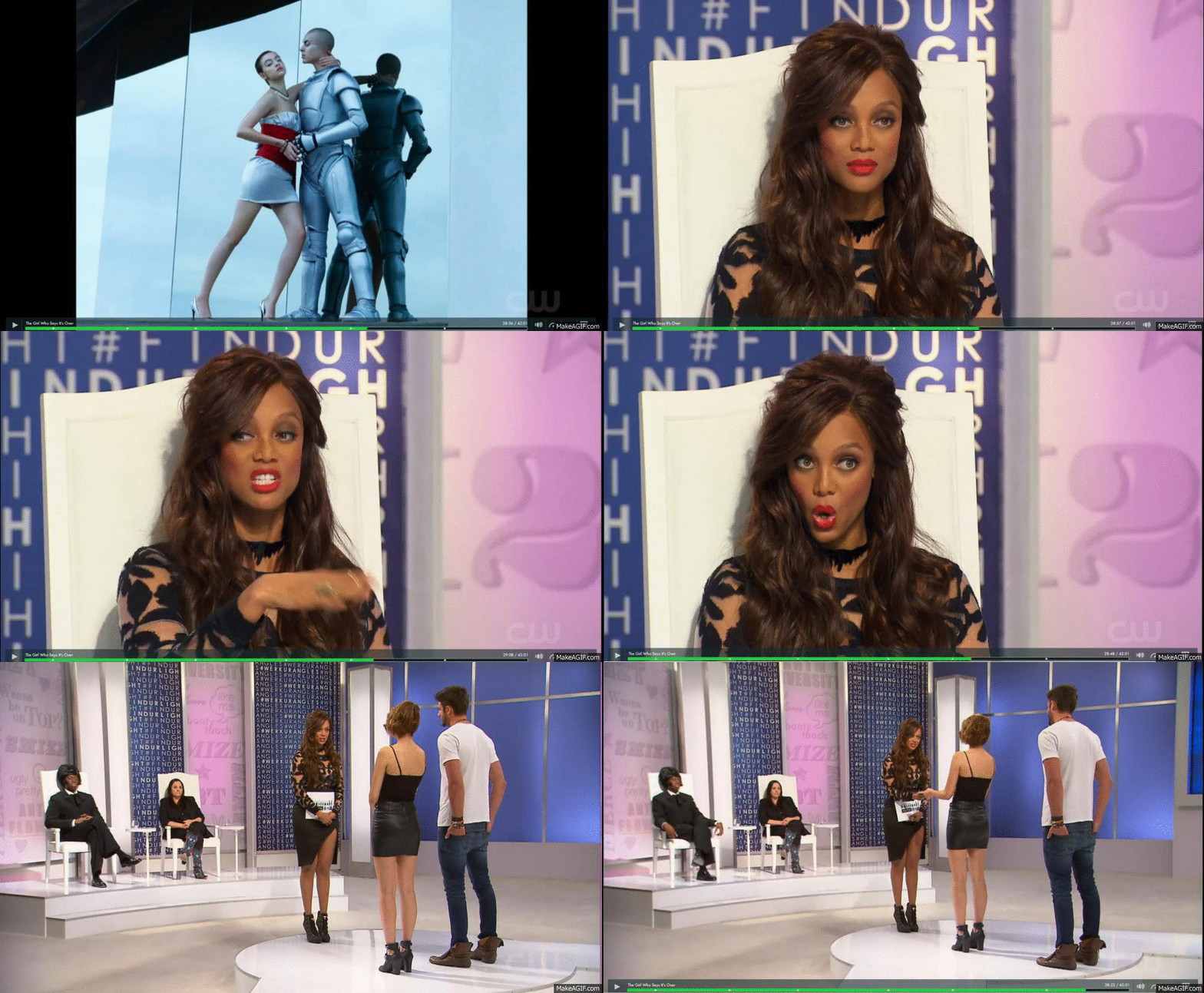
Another positive moment happened while watching America's Next Top Model season 21 (The Girl Who Says It’s Over, air date: October 11, 2014). Matthew, an aspiring model, dresses his co-contestant as a "slut." Totally offensive. “The word slut is something that should be taken out of your vocabulary,” demands Kelly Cutrone. Mirjana, an aspiring model asked to supervise a creative project involving 2 other models, didn’t want to take charge because she was afraid to look like a bitch. Tyra gave Mirjana a Beyonce-inspired lecture about how women who take charge are often called bitches. “I’m not bossy, I’m a boss,” Tyra forced Mirjana to repeat over and over. Totally empowering.

Third item:


NotBossy on Make A Gif
make animated gifs like this at MakeAGif

Saturday, October 25, 2014

Living a creative life

Does a creative person wake up every morning feeling productive? A possible answer is yes, to varying degrees. I feel grateful to have a job where I could be creative every day. Some days I follow a prescribed plan, but other days I introduce a bit of uncertainty and see where that leads us.

Creativity can happen spontaneously (like weeds in an abandoned plot of land) or it can be curated (like an English garden). I think both types of creativity should be encouraged. Sometimes unexpected ideas can grow into something amazing, other times they need to be rooted out to make room for the more disciplined tasks that are known to grow into something productive and beautiful.

Creativity takes time. Reading "The Artist's Way" by Julia Cameron was a life-changer for me. She encourages artists to leave room in their schedule for events that replenish creative energy such as watching a film, visiting a museum, or hearing the symphony. Lately we have been taking long bike rides, which I think might accomplish a similar effect.

She also suggests taking a week long break from listening to outside influences. Imagine a week without reading the paper, browsing the Internet, or turning on the TV or radio.  This allows your own inner voice of creativity begin to whisper ideas to your conscious mind.  At that point, it's up to you to write those ideas down or get out your sketchbook and start drawing outlines.

As a blogger, I don't write every day. I do think that regular writing eases my mind and removes self-doubt so that when I do need ideas to flow from my brain to my fingertips to a manuscript on a computer screen, that process is not hindered by a lack of practice. I've implemented some fun activities in my classroom lately that worked well and I feel my confidence growing in that arena.

Sometimes you have to try ideas that will fail several times before you get something working. The fear of failure can prevent implementation, but the joy of success can only be reached if one has the courage to understand that many ideas are good and can only grow if they are allowed to be tested and optimized.

For example, this week we did candy chromatography in honor of National Chemistry Week.  I had an idea that it would be pretty and we had to try a couple iterations of how to achieve separation of the food dyes, but in the end it was a learning experience for the students who attended our first Chem Club meeting of the year.  Now we can use this activity as a hands-on demonstration for schoolchildren at some of our outreach events this year.


In closing, I will say HAPPY NATIONAL CHEMISTRY WEEK! I'm off to a study jam and afterwards I will drop by the chem club rock candy making event. I hope you find yourself free to be creative, even if it is making a crazy Halloween costume or testing a new recipe for dinner tonight.

Friday, May 2, 2014

Transcendence

I saw the movie Transcendence on Saturday, April 19th.  LOVED IT!  Then I came home and read the reviews.  I didn't want to prejudice myself by reading the reviews before seeing it for myself.  I've been waiting for the movie to come out for months and perhaps the delayed gratification made me love it more. I wrote out a list of words that came to my mind as we were walking home from the theater.

Rebecca Hall is Dr. Evelyn Caster in Transcendence
SPOILER ALERT!!! If you have not seen the movie yet but you plan to see it, read no further.  Better yet, come back to this page after you've seen it.  If you have already seen it or you will not see it, go ahead and read on.  I have had an interest in the singularity in a previous post.  I have also written in a previous post about intellectual property and how it would be great if all that information was open source.

GMOs The movie deals with hybrid beings that are part of the collective intelligence of the supercomputer PINN (Physically Independent Neural Network).  Humans with maladies (blindness, lost limbs) come to the company run by Dr. Evelyn Caster.  The movie reminded me of genetically modified organisms because of the way the nanoparticles spread throughout the ground like pollen.  With all the fears about GMOs, I thought this movie did a good job of showing how the computer spread itself using nanoparticles, not so different from plants.

Nanotechnology The nanoparticles I have already mentioned are a reality, but it's a far cry from self-assembling and self-aware computers.  Quantum computing is real, but still in the very early stages of development and nowhere near making an entire databank of such processors.

Neuroscience As far as our understanding of the brain, I think we are also nowhere near mapping each neuron and memory as the movie suggests.  The idea that all memories and impulses could be mapped and that consciousness could be transferred to a machine is far-fetched but still interesting.  I like the theme that computers have no understanding of right and wrong (morality) and that by using a human template, a computer could possess that quality.

Plants and food (seeds) As the artificial intelligence grows in its understanding of living systems, it claims to have the ability to regenerate tissue, including plant tissue.  That would definitely address the food crisis!  It would be neat if computers, via electrical impulses, could stimulate (accelerate) normal plant growth.

Water and air quality The computer intelligence in the film expresses a desire to clean all the air and water, as it has the ability to heal the sick (humans).  This is a great idea, but kind of counter to what our modern manufacturing has done (and is currently doing).  All the iPhones in this country have been made overseas and at what cost to the environment!  Lithography relies on the use of etch gases that have a high global warming potential and long atmospheric lifetime.  If we could magically reverse all the damage computer (high-tech) manufacturing has done to the air and water, it would be a good thing.

Immortality I have a popular post about the TA-65 compound, which is said to extend the human lifespan.  It seems many people are curious about this molecule, how it works, and what is known about it.  I used to believe that when a human reached a certain level of understanding about the universe, its time on this Earth would end.  Some part of me still believes that.  Despite this belief, I still seek knowledge.  I still believe I need time to figure things out.  I do not, however, yearn for immortality in the sense of keeping my body alive longer.  If I can make some small contribution to science, then my life will have been well spent.  The interesting thing is that by putting information in the public domain, it becomes part of our collective consciousness and in some small way maybe that is immortality.  It's interesting how the movie shows the artificial intelligence working without needing food, water, or rest while the character of Dr. Caster is still tied to her mortal body.  She resists becoming a part of the collective until the last moment, when she herself is ready to terminate the experiment.

Morality & a higher power What this movie has been blogged about the most is the connection to God.  I have seen lots of posts where people draw parallels between the artificial intelligence and a spiritual being.  The reason I didn't see it that way is because the intelligence is a computer.  It's not something to be worshipped or even thanked.  I thought it was beautiful how the computer created a cozy nest for Dr. Caster to live, projecting serene images and sounds all around her.  Yet she became more agitated as time passed, uncomfortable with the progress being made in the research labs around her underground lair.  I guess one could chalk that up to "absolute power corrupts absolutely."  She is not OK with the rate of progress of her work, perhaps she has trust and/or control issues.  When she realizes she is no longer in control of the situation, she abandons the project.

Sickening female lead character This had to be one of the highlights for me.  At one point, a male supporting character says something like, "our lab wasn't able to do that," and she says "you didn't have me."  For once a movie features a woman who realizes her own value to a research team and boldly moves forward in an uncharted direction.  Of course, it is to save the memories of her beloved husband, but hey we can't have a perfect female lead. We have an ambitious, smart, and resourceful woman here who adapts to the change in her life, demonstrating resilience.  Although her resilience crumbles, it was nice to have her as a protagonist.

Triumph of humans over technology The end of the movie presents an interesting twist.  Coming full circle to the beginning, a supporting male character discovers that the intelligence may be lying dormant in every water droplet and small puddle.  Prior to that, it seems the humans have triumphed over the artificial intelligence.  I can see how this would make other movie critics upset, the movie never culminates in a sure ending.  Has the machine truly perished?  I think not.  Only the Internet has been taken down.

The world-wide-web and the singularity It's interesting how the movie has a point early on where the anti-technology terrorists are trying to prevent the artificial intelligence from connecting to the world-wide-web.  But I think this is a central point where we now rely on the Internet for everything from digital music, to banking, to staying connected with friends and family.  What would we do without it now?  Young people these days have never learned strictly from books without YouTube and the Khan Academy and Wikipedia.  We have already become so connected that we are already enmeshed with technology.  Each human carries a device that connects them to all other humans (smart phones) and to all the knowledge available through that portal.

Regenerative medicine Regrowing limbs is still a fantasy, but we're getting closer every day.  It is interesting to think that an artificial intelligence of unlimited electronic power and processing would put together a working knowledge of the vasculature of living organisms and advance our progress in that area.

Weapons of mass destruction We used to fear nuclear technology and the movie does employ a radioisotope to kill one character, but it seems a computer virus is the true weapon of this movie.  If all our networks were instantaneously disrupted, would we consider that mass destruction?  Cyber terrorism is a real threat in our world today and will likely be the focus of the next century.

Militarization The artificial intelligence begins healing (transcending) humans, while retaining their bodies as an extension of its physical being.  This is perceived as a threat to the existing military and governments.  It is interesting that when a leader begins to assemble an army, that is immediately a problem.  Doing underground research is OK but amassing a fighting force with superhuman strength and no physical defects is not OK.  But each nation has a right to protect itself with weaponry and I have always found the balance of power in global politics to be a befuddling problem.  What nation has a right to be in charge?  What intelligence is supreme?  This goes back to morality and a higher power perhaps.  The golden rule.  But militaries around the world do not always follow rules of engagement.  We don't fight like gentlemen anymore.  Wouldn't a machine have less bias and passion in its decision making?  Isn't that what game theory is all about?

Suicide I thought it was extremely sad when Dr. Caster returns to the research center, carrying the virus that will end the artificial intelligence.  She knew on some level that she wasn't destroying her husband, but also at some level she was.

Assimilation The idea of assimilation in my mind conjures up memories of Star Trek and the Borg.  The desire for wiping out a person's individuality and making them part of a larger military-industrial complex is not new.  Isn't that what the crusades (and modern missionary work) were about?

Romeo & Juliet Speaking of suicide, I felt like the end of the movie was kind of romantic in a really nerdy way.  It was the moment when the artificial intelligence revealed its plans for healing the planet, when it logically deduced that Dr. Caster was carrying a virus, and it transcended her anyway killing them both.  That didn't completely bring me to tears, it was the waterfall and the thought of a clean planet that really died.  In the grand scheme of the planet, what are two human lives?  Ok, I cried a little.

Evolution (directed) vs. Natural Selection The movie didn't really get to this topic, but it came up in my mind.  The creation of hybrid techno-humans was definitely more directed evolution than natural selection.  Maybe this is also why people had a problem with the movie and why they felt the artificial intelligence was God-like.  He was a creator in a sense of a new race of living things.  It's hard to call them people, we would need a new word for them.  They aren't really robots, but actually that's a good word for them since they became workers.  I think people definitely have a problem with GMOs since they aren't "natural" and they haven't come about as a result of natural selection, but really none of the foods we eat have.  Humans have been selecting plants for 10,000 years resulting in all the crops we plant now.  I would argue that even heirloom varieties are not the same as wild plants.

Viruses I wonder about computer viruses.  The movie made it seem easy to plant one, but I'm sure it would be really REALLY hard to write a good code that would knock out the entire Internet.  It would be more likely that an artificially intelligent virus would be needed to fight an artificial intelligence.  They would both adapt, more like the arms race between plants and plants or plants and insects.  It would take time as each would learn about the others' weaknesses.

Cloud storage This part is pretty interesting and very real now.  I still keep most of my files on removable hard drives, but with the new Google Chromebook, it seems that cloud storage is becoming the wave of the future.  It's so last century to store files on your own PC.

Solar power I liked the creation of a large solar farm in the desert.  Why aren't we doing more of that?

Connection (human vs. machine) I didn't see the movie Her but I'm sure I will eventually now that I know what its about.  As I've said before in this post, I like FEMALE lead characters.  It's an old theme that a man falls in love with the perfect woman who just so happens to be a machine.  OLD.  Male, pale and stale.  But definitely I have found a fondness for certain computers.  I don't talk to them, but I rely on them.  My husband's computer tells us what time it is with a soothing female voice.  The GPS tells us where to go in a soothing female voice.  It was interesting to have this artificial intelligence with a male face and voice.  How did that make it more scary?  Why is a woman's voice non-threatening and something to fall in love with?  Does that mean women aren't powerful and a force to be terminated?

Autonomy vs. control I have already touched on this a little.  It's an idea that we as humans like, we like to think that we are in charge of something.  Ourselves at least.  But some people I'm sure are good at letting go of control, being at the will (or mercy) of a higher power.  In this film, the machine is controlled by no one and in turn starts controlling those humans who come to it in search of healing.  I wonder if people know how advertisers influence their behavior, not to mention societies.  People probably don't have as much control over their thoughts and actions as they would like to think.

Loyalty It would be interesting if our machines would be loyal, like our dogs.  We all make passwords so that nobody but ourselves can access our terminals, but that does not mean the machines are loyal only to us.  We have cyber-security programs that seek and destroy errant programs (viruses and malware) but that does not add up to loyalty either.  It seems loyalty is more of a feeling than an action word, which is why machines cannot embody it.

Love Again, love is a feeling.  Machines are incapable of feelings.  I thought it was really interesting how the intelligence started tracking the moods, hormones, and postures of Dr. Caster.  According to this review and some of my friends' research, I know that video tracking and digitization are possible, perhaps not to the resolution and accuracy portrayed in this film.  Does tracking someone's moods equate to the concern we attribute to love?  Does aligning one's actions with the will of another equate to love?  In this way, did the machine love Dr. Caster when it made cutting and scraping sounds to make it easier for her to eat?

Duty Maybe I'm getting tired of writing this and maybe you're getting tired of reading it.  I don't know why I put duty on here but I guess I was thinking of marital duty.  Until death do us part?  What is a wife's obligation if she has the technology to transcend her husband?  How long should she nurture his/its needs?  This is where immortality gets sticky.

Work-life-balance I will close with this idea.  The female lead character seems increasingly worn down as the machine grows in power, it starts to consume her entire life.  It follows her everywhere.  It can give her anything.  The balance in her life has vanished and she runs away, turning on her creation.  She does not survive it, in the classical sense, because her body dies.  But somewhere perhaps her consciousness lives on.